From Data to Insight to Action With Decision Intelligence
See how our platform builds a trusted data foundation and contextual intelligence to bridge the gap between data, insights, and action, accelerate time‑to‑value, and enable confident human‑AI decisioning.
From Data to Insight to Action With Decision Intelligence
See how our platform builds a trusted data foundation and contextual intelligence to bridge the gap between data, insights, and action, accelerate time‑to‑value, and enable confident human‑AI decisioning.




Key takeaways
 Accurate, explainable AI decisions depend first on a trusted data foundation and real-world context, not on speed or the newest models. Organizations often over-trust AI while overlooking data accuracy.
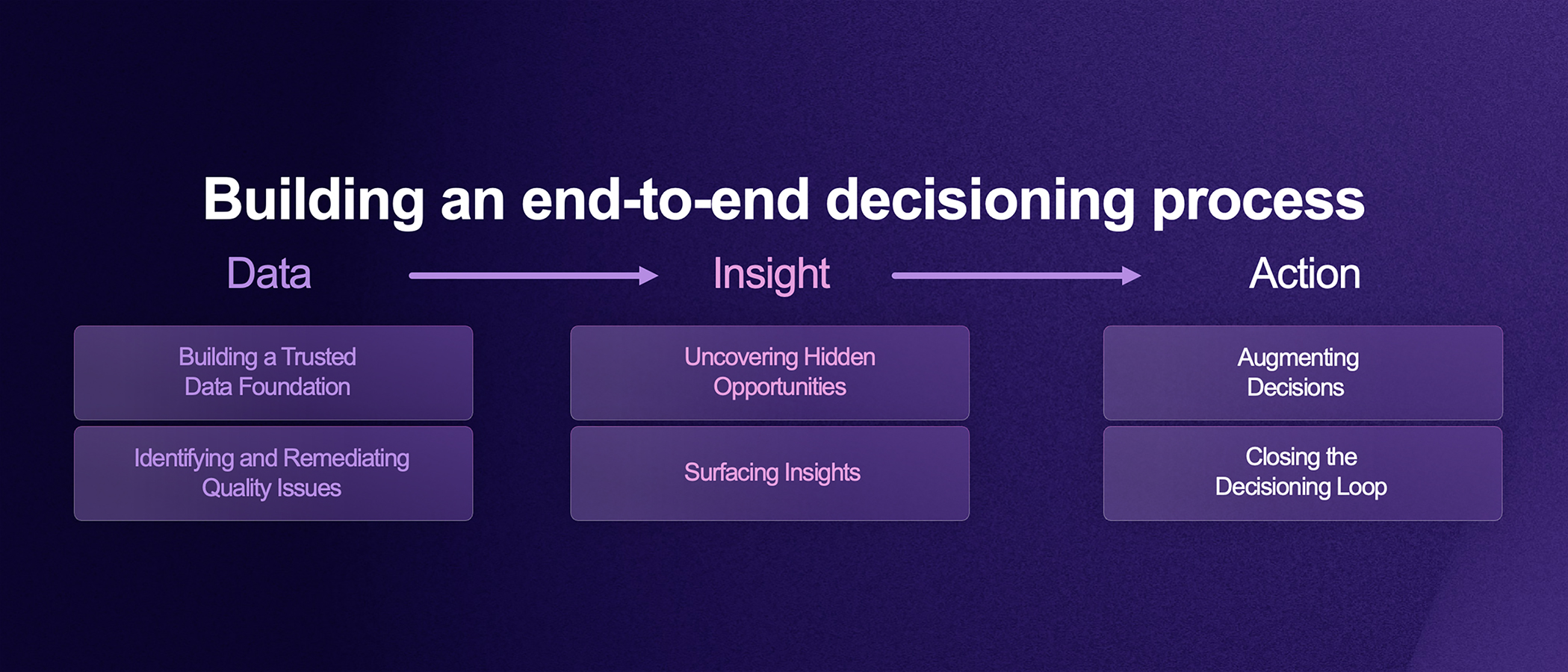
- Quantexa's approach moves through three phases: build a trusted data foundation to fix data quality with entity resolution, reveal hidden insights through a contextual knowledge graph, then close the loop with human and AI decisioning.
- Human-AI collaboration operates across three levels (decision support, augmentation, and automation), allowing organizations to choose when humans must stay solely in control, and where AI can add speed and scale.
Data and technology leaders are feeling the pressure to deliver meaningful AI outcomes at speed. But if you want to win in this era, you can’t just be fast; you need to be accurate. You must operate with speed, agility, and an unshakeable confidence in every decision. There are times when we see organizations becoming overconfident in AI, while overlooking the accuracy of the data feeding the models. The bottom line is that accurate, explainable decisions are built on a foundation of trusted data and real-world context, so you must first address the root cause to achieve measurable, scalable impact from AI.
The real question is how you can reliably turn the data you have today into decisions that matter tomorrow. To do this requires overcoming the traditional gaps between data, insights, and action using an architecture designed for decision intelligence. Instead of starting with AI, this approach begins by building a trusted data foundation, then creating contextual understanding that powers accurate human/AI decisioning.
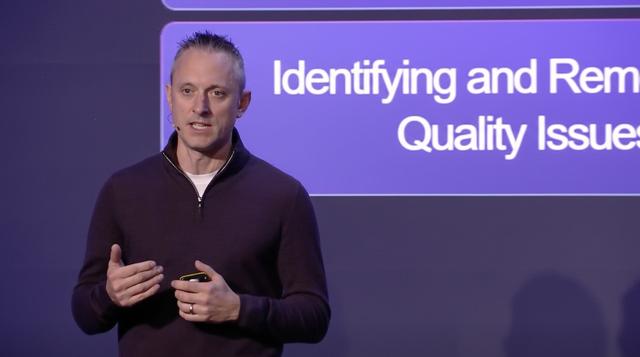
At QuanCon26, we demonstrated live how our Decision Intelligence Platform enables you to move from disconnected raw data to insight and then action in just 20 minutes (You can watch it here). In this article, we’ll break down three key phases of building this end-to-end decisioning process.
1. Build a trusted data foundation before anything else
Every high-value decision begins with the data that feeds it. This requires building a trusted data foundation and remediating data quality issues, which is no small task. Customer, counterparty, and unstructured data sit scattered across disconnected systems, and records are often duplicated or incomplete.
A single, reliable, and accurate view of a customer is the holy grail, but for many, it can feel almost impossible to achieve. Our market-leading automated entity resolution capability uses proprietary matching technology and AI to create a connected, unified view of entities. It understands that ‘Jon Smith’, ‘J. Smith’, and ‘Jonathan Smith’ at the same address are, in fact, the same person. It connects disparate data points to create a single, trusted view of all customers, providing that all-important context that underpins every confident decision.
However, a unified view of your customer is only as good as the data within it. Hidden data quality issues can slow downstream actions, corrupt analyses, lead to flawed decisions, create significant compliance risks, and impact the customer experience. Data quality must evolve from a reactive task to an operational discipline that ensures issues are identified early and remediated in a way that improves upstream systems.
Using Q Assist Workspace, your data stewards don’t need to hunt for data quality problems. Instead, they can use a pre-built Data Quality Agent to automatically review the output of the matching process to look for incomplete records, anomalies, and underlinked entities, before easily creating an automated remediation workflow. This ensures the integrity of your data ecosystem and elevates your data stewards from reactivity to proactive guardians of data quality.
2. Reveal what others can’t see
Once data is unified and trusted, the next challenge is extracting meaningful insights quickly, which is where many analytics programs stall, because without context, insights remain shallow, siloed, or too slow to matter. When you add a contextual knowledge layer on top of your data, everything changes: hidden risks and opportunities become visible, insights become explainable, and you can align around the same full picture. With contextual intelligence, you move from asking “What happened?” to “What matters, and what should we do next?”. Context creates transparency, meaning you can see why an insight appears, what evidence supports it, and how it connects to broader business goals.
From your trusted data foundation, our platform transforms data into a knowledge graph, where an ontology standardizes complex relationships into clear, analyzable structures. With this graph in place, graph data science algorithms trace connections across the ecosystem, revealing indirect relationships, dependencies, and patterns that traditional analytics cannot detect. Your data science teams can then apply scoring or prioritization models to highlight the most relevant signals for the business, whether to identify risk, optimize operations, or discover new growth opportunities.
The output is a set of accurate, contextual, explainable insights that integrate directly into operational workflows, enabling faster, more confident decision‑making across your organization. This enables data science teams to move beyond manual queries and spreadsheets, automatically identifying risk and opportunity in your data to directly inform decisions.
3. Close the loop with human-AI decisioning
Even the best insights are worthless if they never reach the people or systems that can act on them. Decision intelligence helps close the loop by elevating human-AI collaboration. AI can operate across three levels to match the needs of your organization:
Decision support: Contextual insights and recommendations assist human decision-makers so you stay firmly in control.
Decision augmentation: AI accelerates decision‑making by analyzing complex connections, highlighting risks or opportunities, and suggesting prioritized next steps.
Decision automation: AI handles high‑volume, rule‑based decisions and triggers workflow actions, while your teams oversee exceptions and governance.
This approach ensures the right blend of human judgment and AI capability is applied to every decision, improving consistency, speed, and accountability across your organization.
When you bridge the gap between data, insights, and action, decisions move faster, smarter, and more transparently, consistently driving impact.
See it in action
Watch the live demo of how our Decision Intelligence Platform enables you to move from raw, unstructured data to decision‑ready intelligence in just 20 minutes. We walk through how the platform unifies and cleans data, surfaces contextual insights, and triggers real actions in business workflows.