
The Power of Knowledge Graphs in Fighting Sanctions Evasion
Multi-hop analysis uncovers hidden actors across complex networks, giving organizations a predictive edge.



Sanctions are a critical tool in today’s global policy landscape, but as the world becomes more interconnected, sanctioned individuals and organizations are getting smarter and more elusive. The challenge for banks, regulators, and investigators is not just to keep up, but to stay ahead, identifying not only those already on sanctions lists, but also the central figures hiding in plain sight, often many steps removed from the obvious suspects.
The power of seeing the whole network
Recent Quantexa investigations have revealed a striking truth: the most influential actors in sanctions evasion are often not hidden in the shadows, but operating in plain sight. They are present in the network, just not directly connected to entities we already know about.
In one case, our analysis surfaced a chairman of a major bank, under criminal investigation, who was linked to sanctioned actors through a web of business relationships. In another, a former head of state was found to have significant ownership in a business tied to a sanctioned organization.
These central figures were not on any sanctions list at the time, but their connections, sitting many “hops”—or relationships—across the network, placed them at the heart of illicit activity.
What is remarkable is that these discoveries were made before some of these individuals were officially sanctioned. By mapping the full context of relationships, Quantexa can flag high-risk entities for further scrutiny, giving organizations a predictive edge in the fight against financial crime.
Introducing multi-hop analysis
Traditional investigations often focus on direct links: who owns what, who sits on which board, who transacts with whom. But real-world risk doesn’t stop at the first connection. Criminal networks, money launderers, and sanctions evaders deliberately structure their activities to avoid detection, using layers of intermediaries, shell companies, and cross-jurisdictional ties.
Multi-hop analysis explores not just the immediate connections (one “hop” away), but the entire web of relationships—two, three, or even sixteen hops out from a starting point. In graph theory, a “hop” is simply a step from one entity to another along a relationship (like ownership, directorship, or transaction).
By starting with a set of “seed entities,” known sanctioned organizations or individuals, or those highlighted in investigative journalism, Quantexa graph analytics can traverse the knowledge graph at the very largest scale, uncovering indirect links that would otherwise remain invisible. The most famous result of graph analytics is that we are all connected somehow, expressed in the parlor game of six degrees of Kevin Bacon.
Quantexa’s approach can highlight those connections which are too strong to be a coincidence, ignoring the innocent mass of connection who somehow share a coincidental link but don’t represent risk.

Figure 1. A fragment of the network of an actual Entity of interest (teal) that was surfaced through multi-hop. The Entity had 76 connections to confirmed sanctioned seed Entities (red) and 56 investigative journalism seed Entities (orange). Some seeds were connected to the found Entity of interest through as many as 16 hops.
Quantexa's Knowledge Graph (QKG) provides a rich, contextual entity-to-entity set of relationships, that brings together billions of data points from internal and external sources, resolving entities (people, companies, addresses, etc.) and maps their relationships. The result is a living, breathing map of real connections, where context is king and hidden risks can be surfaced with unprecedented clarity.
Any graph can be represented in multiple different ways. Counting hops through both individuals and businesses is the right graph approach to detect this type of sanctions activity. Other problems require a different perspectives. QKG’s patented ‘perspectives’ allow such analysis at the scale that is required.
How Quantexa’s multi-hop outpaces graph databases
So why can Quantexa surface connections over 7, 10, or even 16 hops at scale in the described case when most graph databases struggle beyond a handful without incurring computational expense, performance issues or timeouts on large graphs?
Due to Quantexa’s unique platform architecture, including the Quantexa Knowledge Graph, entity resolution, scalable graph analytics, and business context combine in one powerful workflow.
Entity resolution at scale: Quantexa’s platform doesn’t just ingest data; it cleanses, parses, and resolves it, ensuring that every “node” in the graph represents a real-world entity, not a duplicate or fragment. This ensures accurate analysis and investigation, especially when dealing with global data sources of varying quality.
Contextual graph generation: QKG handles billions of entities and relationships, supporting analytics-first data science investigations. Unlike traditional graph databases, which require pre-defined ontologies and can become unwieldy as networks grow, Quantexa’s approach is flexible, schema-agnostic, and optimized for performance.
Efficient multi-hop traversal: With its patented perspectives and contextual focus, Quantexa can traverse deep into and across the graph, surfacing relevant entities many hops away from the seed.
Explainability and actionability: Each connection surfaced by multi-hop is explainable, with clear paths and contextual information that investigators can use to make informed decisions. Finding more connections is a great start, but finding and explaining the right connections for risk, compliance, and operational action needs full decision lifecycle capabilities.
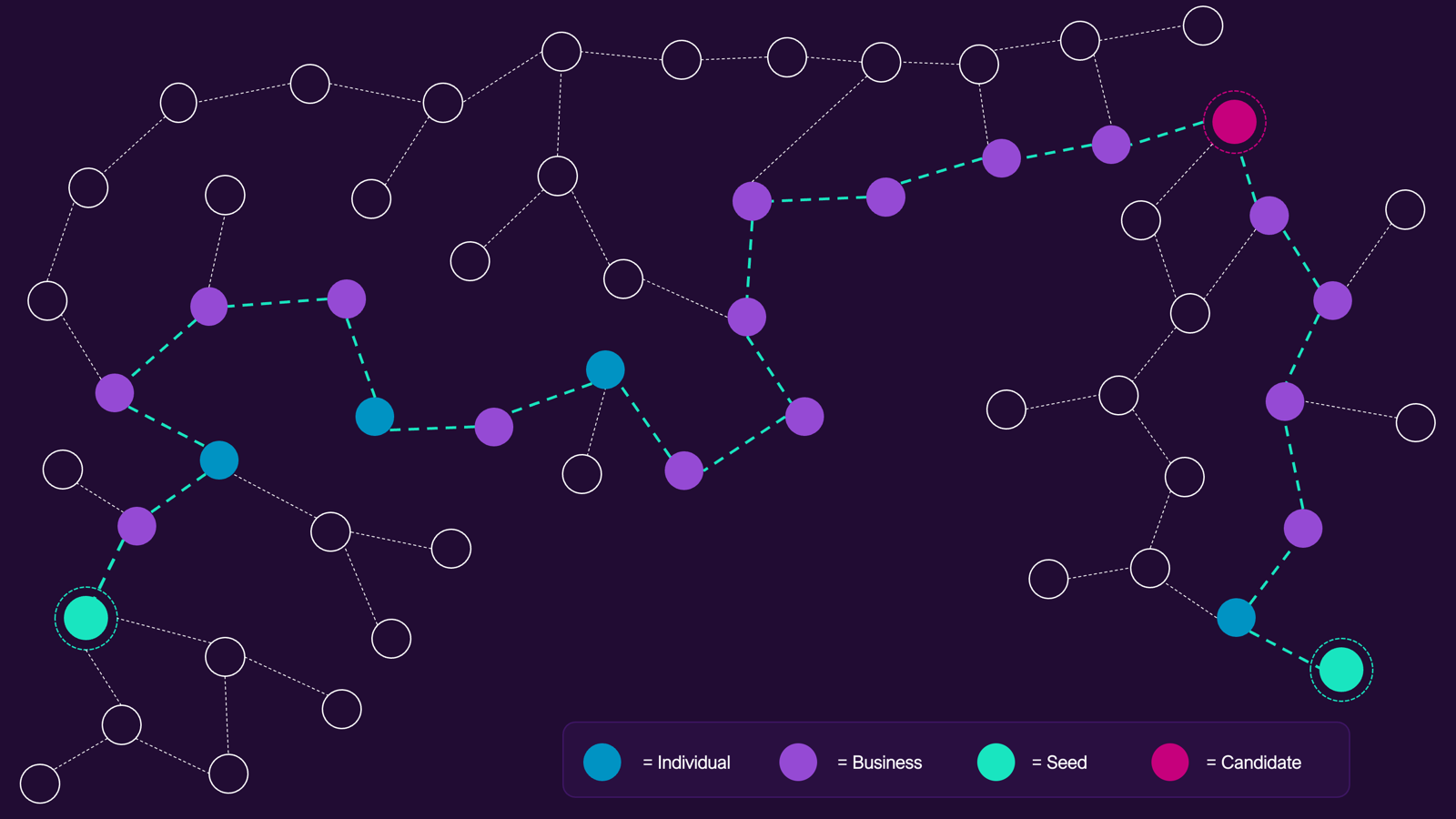
Fig 2: The found entity is 16 hops from one seed, 6 from another.
Central figures are hidden in plain sight
The key outcome: central figures in sanctions evasion and financial crime often hide in plain sight, several or many steps removed from the obvious suspects. When using multi-hop analysis on a contextual knowledge graph, organizations can proactively identify these actors sometimes years before they appear on official lists.
This isn’t just a technical capability; it’s a strategic operational advantage. It helps banks to protect themselves and their customers from reputational and regulatory risk. Investigators can focus their efforts where they matter most, identifying bad actors in an increasingly complex world, often right in front of us, hidden in plain sight.
Indeed, in our example, after investigating a statistically significant sample of the relationships uncovered by the multi-hop analysis, we see that almost 50% of the discovered nodes were confirmed sanctioned entities. This is a high number and a signifier that other high-risk individuals may be present in the graph, and worthy of additional scrutiny.
Want to learn more about Quantexa’s multi-hop analysis capabilities ? Watch the webinar, How Knowledge Graphs Help Identify Bad Financial Actors at Scale.
 Loading...