
What Is Data Modernization and Why Is It Important?
This guide explores how data modernization can transform enterprise operations and decision-making. It covers what data modernization is, how the process works, the benefits and challenges organizations face, and practical strategies for successful implementation.


Many enterprises struggle to trust the data to make their decisions. Years of mergers and acquisitions, quick technical fixes, and changing requirements have left them with disconnected tools and aging legacy systems. This can create an ecosystem of costly data management technology that struggles to keep pace with rapidly growing structured and unstructured data volumes and hinders insight and intelligent, real-time automation.
Businesses need a clear data modernization strategy if they want to stay competitive manage total cost of ownership and extract full value from their data. Doing so elevates data quality and accessibility, ensuring it's primed and ready for different business use cases. It provides a reliable foundation for advanced analytics and human/AI decisioning.
What is Data Modernization?
Data modernization is the process of updating an organization's data infrastructure so it can support business needs. It spans a range of activities, from migrating legacy data management technology to the cloud through to unifying vast quantities of siloed information and implementing modern master data management (MDM).
A data modernization strategy might look slightly different from one business to the next. But ultimately, modernization is about helping an organization extract more value from its data with lower total cost of ownership. This is achieved by creating a trusted, reliable foundation that can be accessed across the entire business.
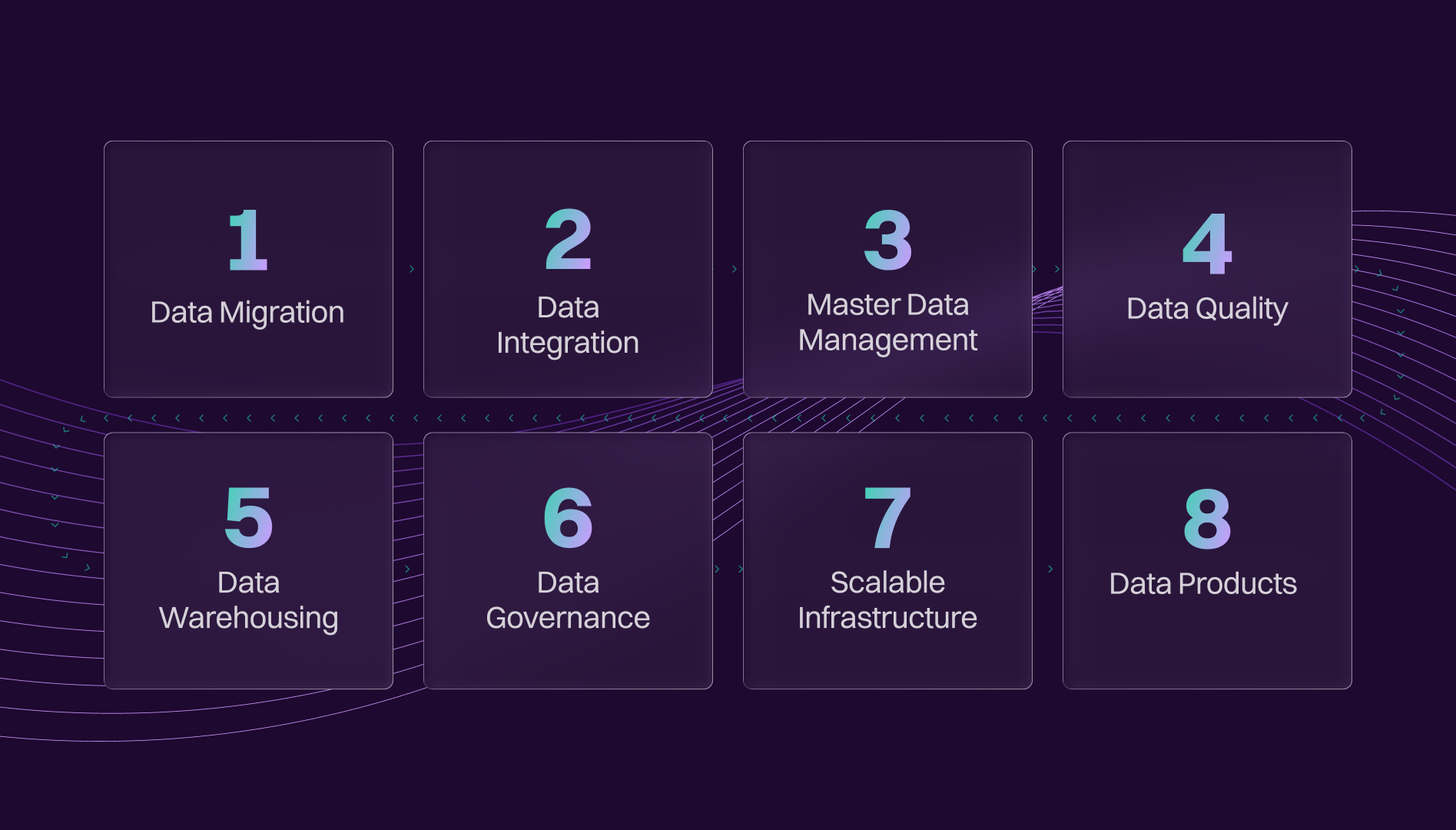
The key components of data modernization
Data migration: Data is moved from legacy systems into modern platforms, either on-premise or in the cloud. This involves transferring data safely into the new environment while aiming to keep business disruption to a minimum.
Data integration: Data gets consolidated from across various systems, such as CRM, ERP, billing systems, MarTech and PIM tools. This gives the company a more reliable, unified view of its data and reduces the need for manual reconciliation between systems.
Data products: More organizations turn high value datasets into reusable and well-governed data products. While this enables data teams to increase efficiency in delivering trusted data, it makes it easier for business teams to access the data they need through data marketplaces.
Master data management (MDM): Core business entities (e.g. customers, products, suppliers, or accounts) are reconciled across systems into consistent, trusted golden records. Modern MDM platforms match records from multiple sources to create unified entity views, with high accuracy in batch and real-time, deliver value in shorter timelines and are scalable to handle today's data volumes and sources.
Scalable infrastructure: Storage and processing environments are upgraded so they can handle growing data volumes and changing workloads. For example, cloud platforms allow computing and storage resources to scale up or down as demand changes. And on-demand and fully managed IaaS and PaaS providing the agility to automatically commission fully softrware-defined environment with best-in-class management.
Data quality: Inconsistencies such as duplicate records and outdated information are identified and resolved, improving accuracy and establishing a more dependable dataset.
Data lakehouse: Data is consolidated into a centralized repository designed for analytics, reporting, data science and AI. Modern data warehouses, along with lakehouse architectures, allow organizations to aggregate large volumes of structured, semi-structured and unstructured data efficiently.
Data governance: Clear frameworks are established to control how data is managed and used across the organization, helping protect sensitive information and support regulatory compliance.
And on-demand and fully managed IaaS and PaaS providing the agility to automatically commission fully softrware-defined environment with best-in-class management.
Why data modernization is increasingly important for enterprises
Think of an enterprise that's been adding systems and tools to support compliance and growth for the past couple of decades. Years of incremental upgrades and short-term integrations have resulted in a patchwork of disconnected platforms and inconsistent records.
Today, the use cases for data have evolved far beyond what those systems were originally designed to support. Enterprises rely on data to power real-time decision-making and intelligent automation, therefore making rapid access to a unified, high-quality view of data essential.
The rise of AI initiatives has intensified this challenge. The limitations of inconsistent or unreliable data quickly become clear when organizations attempt to scale AI (e.g. through predictive models, automation, or AI agents). Many legacy environments also lack the infrastructure needed to support modern AI workloads.
Let's take a closer look at some of the key risks enterprises face when a data modernization strategy isn't implemented:
Data silos and unreliable information
Data spread across multiple systems creates conflicting records and duplicated information. The enterprise lacks a trusted data foundation, resulting in unreliable reporting and insights that lack credibility.
Failure to harness AI-powered decisioning and real-time analytics
AI powered decision-making depends on access to up to date, reliable data. Legacy systems fail to provide this, and outdated infrastructure makes it harder to scale real-time analysis. As a result, AI and Agentic AI initiatives struggle to get off the ground.
Cumbersome and expensive data processing
Legacy infrastructure is likely to require specialist maintenance and manual intervention over time. And so the cost of sustaining outdated systems ends up outweighing the investment needed to modernize them.
Compliance and governance risks
Fragmented environments make it harder to track data ownership and enforce access controls. Demonstrating regulatory compliance becomes increasingly difficult.
Legacy vendor lock-in costs
Enterprises that built their data infrastructure around legacy vendors often find themselves constrained by proprietary formats, rigid licensing models, and escalating support costs. Switching becomes prohibitively expensive, not because the technology is the best fit, but because years of deep integration make migration feel too risky. This lock-in limits the ability to adopt best-of-breed solutions and leaves enterprises dependent on vendor roadmaps that may not align with their evolving needs.
End of support for on-premises infrastructure
Many on-premises data platforms are approaching or have already reached end-of-support milestones, meaning vendors no longer issue security patches, performance updates, or technical fixes. Continuing to run unsupported infrastructure exposes the enterprise to vulnerabilities and places the full burden of maintenance on internal teams. Beyond security risk, end-of-support systems fall behind on the capabilities needed to support modern workloads, from real-time data pipelines to AI and machine learning integration, making the case for modernization both urgent and commercially sound.
Data modernization addresses these risks by redesigning the data environment so data is unified and governance is built in from the start.
The data modernization process: From assessment to optimization
Data modernization is a structured transformation that unifies data across systems into a coherent, trusted and contextual data foundation.
Define your business goals
Data modernization is frequently treated as a technical exercise, with success measured by IT risk reduction and cost savings alone. The programmes that deliver the most value are those clearly linking technical activities to business value. Therefore, first, an organisation needs to define what it hopes to achieve by implementing a data modernization strategy. For a bank or insurer, this might include things like enabling faster, more accurate fraud detection, strengthening compliance and providing better customer experience. For a government institution, it might be to harness the power of data to improve service to citizens.
Defining clear, measurable goals from the outset provides a critical framework for any data modernization project, ensuring value-add is both tangible and aligned with business priorities.
Assess your data landscape and create a plan
Next, it's critical to gain a clear understanding of the organization's current data landscape. This will involve steps like mapping existing systems, identifying data silos across potentially hundreds or thousands of sources, reviewing integration points, and assessing data quality. You might discover:
Inconsistent or overlapping records across systems
Manual reconciliation processes between departments
Legacy platforms that limit integration
Inconsistent data definitions and formats
Gaps in governance or unclear ownership
Reporting workflows that can't keep up with business demands
Data modernization addresses these gaps by creating a more connected environment where data quality is enhanced and governance is much stronger. So organizations gain a unified, trustworthy data foundation instead of having to deal with disconnected systems and conflicting records.
Design a modern data architecture
Organizations can now define how their future data environment should operate. This includes decisions around cloud adoption, centralized storage, integration frameworks, and access controls.
At this stage, the focus shifts from simply replacing legacy systems to building a coherent data foundation. This allows organizations to adopt new technologies more easily and respond faster to evolving business needs.
Unify and migrate data
Data is then migrated to modern platforms. Integration pipelines are built or redesigned so systems can exchange information consistently.
It's critical to make sure that fragmented records are reconciled before they're migrated, as transferring duplicated or inconsistent data into a new platform risks recreating the same problems at scale.
Embed governance and security
Data modernization should improve how data is governed and controlled. Therefore, organizations should define who owns critical datasets and how access to them is controlled from the outset. This is especially important given today's heightened cyber threat landscape, where cloud-based infrastructure introduces additional attack vectors.
Governance frameworks are particularly important in regulated sectors. Regulations such as GDPR, BCBS 239, and the EU AI Act place direct obligations on how data is stored, accessed, traced, and used. Requirements must be designed into a modernized architecture from day one. A well-structured governance framework ensures that new systems meet these obligations without introducing new risks, and provides the audit trail and data lineage capabilities that regulators expect.
Continuously optimize and improve
The new data environment is regularly evaluated. That might include continuously monitoring data quality, running periodic audits, and prioritizing improvements where they deliver the greatest business value. Teams might refine data models as business definitions evolve or update governance controls as regulations change.
Continuous optimization means the environment remains reliable and aligned with business priorities rather than drifting back into fragmentation.
Enable advanced analytics and intelligent decision-making
Organizations can now more confidently move ahead with advanced analytics and AI. Decision intelligence capabilities are significantly enhanced, from real-time fraud detection to predictive maintenance and customer insight. These capabilities help organizations stay competitive in a world of advancing technology and rising expectations.
Data modernization vs. data migration: What's the difference?
Data migration and data modernization are related but not interchangeable. Data migration involves the complex and resource-intensive process of moving from one system to another. But data modernization looks at the bigger picture; how data is stored, connected, governed, and used. It reshapes the architecture around the data instead of just relocating the information. As we outlined above, that might involve redesigning integrations, improving data quality, embedding governance controls, and creating a more scalable foundation.
It helps to think of data migration as one critical step within a data modernization strategy.
Category | Data Migration | Data Modernization |
Purpose | Relocate data to a new platform or environment to improve performance, reduce infrastructure risk, or enable cloud adoption | Redesign the broader data environment to improve integration, governance, quality, and long-term scalability |
Scope | Focused on specific systems or datasets | Organization-wide transformation across systems and workflows |
Role in Strategy | Often a by product of application architecture changes | Driven by comprehensive enterprise data architecture that may include migration, integration redesign, and governance reform |
Impact on Data Quality | Data may be transferred largely as it exists | Data is unified, assessed and remediated to improve reliability |
Governance & Controls | Existing controls are typically carried forward | Governance models are reassessed and strengthened |
Long-Term Outcome | Updated technical environment | Future-ready data foundation designed to support analytics and AI |
The benefits of data modernization

A single, trusted view of contextual data
Organizations get access to a trusted, unified view of data. Fragmented datasets are connected and reconciled, so the business no longer needs to deal with multiple variations of the same customer or transaction across different systems.
What gives businesses the actual competitive advantage is context. Not only deduplicating records but also identifying relationships between real-world entities to better identify risk, fraud and growth opportunities.

Faster, more reliable decision-making
A unified, contextual data foundation helps transform the way decisions are made across the business, from forecasting future outcomes and identifying trends to responding to emerging risks.

Significantly reduced operational friction
Modernization improves integration and strengthens data quality. Systems are designed to work together so processes become more streamlined. For example, teams no longer have to export data or reconcile reports manually, meaning work becomes faster and more accurate as data is more trusted.

Improved customer experience
Fast access to connected customer data with context makes it possible to offer hyper-personalized customer experiences, and to tap into what customers really want. Having access to context is the ingredient that makes it possible. It also provides greater opportunities for targeted marketing. The way businesses acquire and meet the needs of customers is transformed.

Lower operating costs over time
Legacy systems are expensive to maintain, often requiring specialist support and ongoing fixes to keep integrations working. Modernization simplifies the environment by retiring redundant systems and replacing manual processes with automation. Over time, this reduces operating costs and offsets the initial investment.
Where does your organization stand today?
Your organization might fall into one of the following broad data maturity stages:
Dysfunctional: Data is siloed across systems and integration is limited. Reporting relies on manual reconciliation.
Embryonic: Some systems are integrated and cloud adoption may have begun, but data quality and governance practices are inconsistent. There is no contextual view of data.
Established: Core datasets are unified and integration is more reliable. Governance standards are clearly defined and enforced.
Advanced: Data flows consistently and in real time across the organization and quality is actively monitored. Advanced analytics or AI initiatives are supported by a stable foundation including a contextual view of data
Understanding which stage your organization is currently at gives you a clearer idea of next steps. It’s worth keeping in mind that modernization is more manageable when progress is measured incrementally rather than treated as an all-or-nothing transformation.
Real-world data modernization use cases
Data modernization is not just about moving data to the cloud or cleaning up siloed records. Its real value comes from creating trusted, contextual views of data — where entities such as people, organizations, accounts, transactions, products, and locations are connected and understood in relation to one another. This context allows organizations to make faster, more confident decisions at scale.
Below are examples of how organizations use modernized data foundations to enable high‑impact, decision‑critical use cases across industries.
Banking and financial services
Key focus areas: Financial crime prevention, risk management, customer intelligence
Financial institutions operate in environments where risk rarely exists in isolation. Fraud, money laundering, and compliance failures often emerge from networks of related entities and behaviors, not single transactions.
With a modernized data foundation, banks can:
Detect financial crime more effectively by unifying and contextualizing customer, account, transaction, and third‑party data. Rather than assessing isolated events, investigators can see how individuals, businesses, and transactions are connected, revealing hidden patterns of fraud or money laundering.
Strengthen AML and KYC processes by building accurate, dynamic entity profiles that incorporate ownership structures, beneficial owners, counterparties, and behavioral history — improving risk scoring and regulatory reporting.
Enhance customer intelligence by understanding customers in context: how they interact across products, channels, and relationships. This supports more relevant offers, reduced false positives, and better overall customer experiences.
Improve credit risk assessment by integrating internal credit data with external signals including market indicators, macroeconomic feeds, and counterparty relationships. A connected view of borrower networks and dependencies allows institutions to identify concentration risk earlier and make faster, better-informed lending and exposure decisions.
Strengthen supply chain resilience by mapping supplier networks and monitoring third-party dependencies in real time. When institutions can see how financial stress or disruption propagates across a supply chain, they are better positioned to act ahead of default risk and protect their lending portfolios.
Here, data modernization enables decision intelligence, not just reporting — helping banks move from reactive detection to proactive risk management.
Insurance
Key focus areas: Underwriting accuracy, claims integrity, operational efficiency
In insurance, outcomes are driven by understanding risk in context — across policies, claims, assets, policyholders, and third parties.
A modernized data environment allows insurers to:
Improve underwriting decisions by unifying policy, claims, customer, asset, and external data into contextual risk views. Underwriters gain clearer visibility into prior behaviors, exposures, and interconnected risks.
Detect claims fraud by identifying suspicious networks across claimants, service providers, vehicles, and locations — uncovering patterns that would be invisible in siloed systems.
Accelerate claims handling through integrated, trusted data that reduces manual validation and supports straight‑through processing where appropriate.
Instead of treating each policy or claim independently, insurers operate with connected, entity‑centric views that improve accuracy, speed, and fairness.
Government and public sector
Key focus areas: Case management, service delivery, compliance and oversight
Public sector organizations manage complex populations, programs, and services — often across fragmented departments and data sources.
Data modernization enables agencies to:
Deliver more joined‑up citizen services by connecting data across departments, agencies, and programs. This creates contextual views of individuals, households, and organizations, reducing duplication and improving service coordination.
Strengthen case management and safeguarding by understanding relationships between people, addresses, assets, and prior interactions, helping identify vulnerability, risk, or eligibility more accurately.
Improve oversight and compliance through clearer lineage, ownership, and transparency — enabling regulators and auditors to trust the data behind decisions.
With contextual data, agencies move from fragmented records to holistic, citizen‑centric decision-making, improving outcomes while maintaining strong governance.
Healthcare
Key focus areas: Patient safety, population health, operational insight better integration with for ex. social care.
Healthcare environments generate vast amounts of data across clinical, administrative, and operational systems — often without a unified view of the patient or care pathway.
Modernized data foundations allow healthcare organizations to:
Create longitudinal patient views by connecting records across providers, treatments, locations, and systems — reducing duplication and improving care continuity.
Identify population level risks by analyzing contextual data patterns across demographics, conditions, and service usage.
Improve operational planning by understanding how patients, facilities, staff, and resources interact, supporting better outcomes and capacity management.
Here, context transforms data into actionable insight, helping clinicians and administrators make safer, more informed decisions.
Practical strategies for successful data modernization
Organizations that treat their data modernization strategy as an enterprise capability transformation rather than a technology migration are more likely to succeed.
Well thought-out modernization programs also prioritize delivering tangible outcomes early in the process. Naturally, this level of transformation is likely to unfold over several years. But that doesn't mean an organization can't aim to release high-value data products or analytics capabilities clearly linked to business use cases within the first few months.
Delivering tangible outcomes early helps demonstrate return on investment and encourage adoption across the business.

Treat data as a product
Treat reusable and high-value datasets as products. Each data product should have clear ownership, supported by documentation and defined service standards.
Doing so means teams can find and reuse trusted data more easily. This supports analytics and AI-driven decision-making.

Prioritize high-impact domains first
Rather than attempting broad transformation, identify data domains that drive measurable value, such as customer data, transactions, or claims.
Starting with focused, high-impact areas reduces risk and creates momentum.

Leverage AI-assisted migration
AI-assisted tools can analyse legacy applications, source code, and configurations to accelerate migration onto modern platforms. This helps teams understand system dependencies more quickly and lowers the cost and effort involved in retiring legacy components.

Adopt modern MDM capabilities
Master data such as customers, products, and suppliers still needs consolidation and stewardship. Modern MDM platforms must handle large volumes of messy, multi-source data, helping organizations maintain consistent entity records across systems at enterprise scale.

Improve visibility into data quality Continuously monitor data quality on unified data so issues are identified early. Measuring quality over time helps organizations prioritize remediation where it delivers the greatest business value and prevents unreliable data from spreading across systems.

Treat modernization as iterative
Regularly assess how the data environment is performing and where improvements are needed. Make defined checkpoints a part of your strategy, so you can evaluate progress and adjust direction as business needs evolve.
Advancing data modernization with trusted data
Data modernization gives organizations access to a fundamentally stronger data environment. Teams work from consistent, connected information instead of fragmented systems and conflicting records. This supports much faster, more accurate real-time decisions and advanced analytics. A trusted, AI-ready data foundation means that organizations can also scale machine learning and intelligent automation far more effectively.
Modernize your data estate

Common challenges in data modernization
Data modernization can surface challenges that aren't always visible at the outset. From technical complexity to organizational alignment, these issues can slow progress if not addressed early.
1. Hidden data complexity
The Challenge | Legacy systems often contain undocumented dependencies and inconsistent data structures that only become visible during detailed analysis. |
The Solution | Invest time in early data profiling and system mapping. A clear understanding of how systems and datasets interact reduces disruption and prevents mid-project redesign. |
2. Fragmented ownership and accountability
The Challenge | Critical datasets are sometimes shared across departments without clear end-to-end ownership. This can lead to inconsistent standards and delayed decision-making. |
The Solution | Define who owns core data domains and how decisions about schema, access, and quality are made. Clear accountability prevents governance gaps from reappearing over time. |
3. Resistance to operational change
The Challenge | Modernization is likely to change workflows and responsibilities. Teams used to legacy tools might hesitate to adopt new processes, particularly if the benefits are not immediately visible. |
The Solution | Involve business users early and communicate practical improvements clearly. Demonstrating real operational gains builds trust and supports adoption. |
4. Managing regulatory and security risk
The Challenge | In regulated sectors, modernization must align with strict compliance requirements. Poorly planned changes can create audit gaps or security exposure. |
The Solution | Embed compliance and security controls into architectural planning from the start. Governance should evolve alongside infrastructure, not after it. |
Data Modernization FAQs
What is the difference between data migration and data modernization?
Data migration is the process of moving data from one system to another, while data modernization involves redesigning the overall data environment. Data migration is one step that sits within a wider data modernization strategy.
Migrating data commonly involves steps like shifting records from an on-premise database to a cloud platform. It usually focuses on relocating data without necessarily changing how it is structured or governed, unless it’s part of an application migration.
Data modernization focuses on ensuring systems are better and more consistently integrated, data quality is improved, and governance is strengthened.
What is an example of data modernization?
An example of data modernization is a bank consolidating customer data from separate, legacy credit card, mortgage, and CRM systems and associated legacy data platforms into a modern data platform. This is often based on a lakehouse, combining cost-effective storage and compute for multiple workloads such as data engineering, business intelligence and analytics, data science and AI. Technologies like Quantexa can accurately match, merge and deduplicate data in the lakehouse, and provide an accurate view of relationships between different real-world entities such as customers, transactions, products. Instead of maintaining duplicate records across departments, the bank creates a single, consistent customer profile a unified graph of wider context including family, organisational, device and financial relationships.
This allows better detection and prevention of financial crime, increased opportunities for cross-sell and up-sell, and operational efficiencies across the organization.
Why is data modernization important for regulated industries?
Data modernization is particularly important in regulated industries because compliance depends on accurate, traceable data - if not defensible under scrutiny, outcomes can be material. Fragmented systems make it harder to demonstrate control over sensitive information and aggregate and deliver accurate data to respond quickly to audits. Regulations like BCBS239 emphasize the importance of quickly and effectively unifying data and delivering insights for compliance purposes.
Modernized data environments improve visibility and strengthen oversight. They also make reporting more reliable. This reduces regulatory risk and creates room for innovation in areas like fraud detection and public service delivery.
Useful links
We’ve discussed a lot regarding Data Modernization in this guide. However, there could be more you want to know about the impact it can have on your organization. Browse the following articles for further reading.