

AML Investigations and Case Management: A Guide to Detecting and Combating Money Laundering
Money laundering can be a challenge for leading financial institutions. Learn more about how AML practices help prevent and combat this financial crime.

Financial crime investigations struggle with a critical lack of context as threats become more complex and networked. Fragmented data, siloed systems, and manual processes reduce visibility, slow decisions, and erode confidence. As organizations adopt AI, the absence of connected, contextual data becomes an even greater barrier to impact and scalability.
Illicit financial flows are projected to hit $4.5 trillion to $6 trillion by 2030
Source: Secretariat
Estimated 2–5% of global GDP laundered annually
Source: UNDOC
HOW WE SOLVE IT

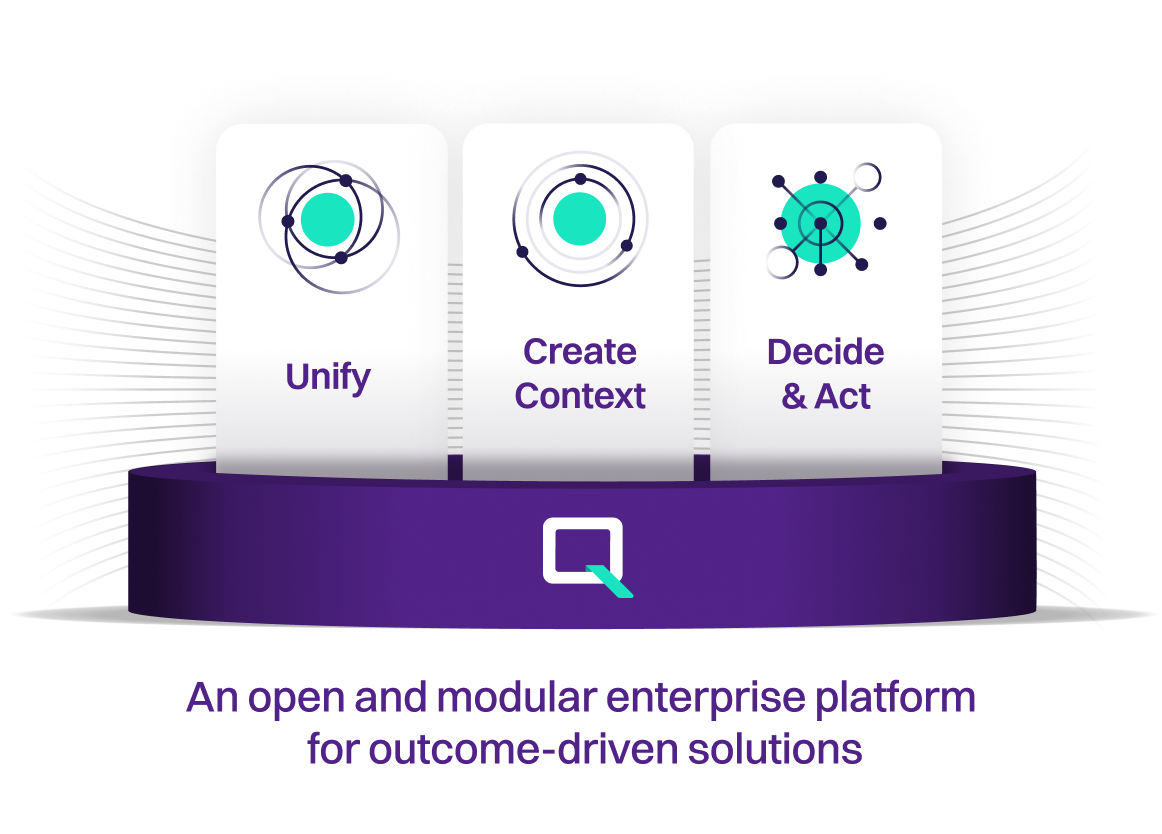
Connect internal and external data to create a holistic view of entities, moving beyond isolated transactions to true investigative context that uncovers organized networks.
Apply advanced analytics and AI to cut through noise, clearly identify true risk, and guide investigators to the right decisions at the right time.
Ground AI outputs in rich context to ensure transparency and explainability, strengthening investigator confidence while meeting regulatory and operational requirements.
Reduce manual effort, focus resources on the highest risk cases, and enhance existing workflows to enable a coordinated, proactive response to complex financial crime.
THE IMPACT
in investigation time (at scale)
data resolution
spent on investigations




See how connected internal and external data and network analytics uncover hidden risk across customers and counterparties revealing patterns traditional AML controls miss.
Build a trusted data foundation to deliver context for decision-making.
Learn moreEnhance customer experience and accelerate revenue growth with a 360-degree connected view of customers.
Learn moreDetect risk in real time to identify unknown risks and deliver more accurate risk ratings.
Learn moreRevolutionize risk assessment with a holistic understanding of borrowers, their counterparties and relationships.
Learn moreUncover hidden fraud risks with a contextual approach to detection and prevention.
Learn moreReduce false positives and focus on real risk by modernizing your AML monitoring, detection, and investigation.
Learn moreRules-based transaction monitoring systems have several limitations and challenges, which have historically hindered their effectiveness in detecting and preventing financial crimes.
For example, the rules and thresholds need to be manually created and updated, making the system less adaptable to evolving and emerging threats. Similarly, rules-based systems also typically analyze individual transactions in isolation and may not provide a comprehensive view of customer and counterparty behavior or relationships. They may miss the connections between seemingly unrelated transactions or accounts, which can be crucial in identifying more complex fraud networks or money laundering schemes.
In contrast, by combining multiple internal and external datasets all at once, Contextual Monitoring transforms the view of risk to a gain clearer understanding of customers, counterparties, their relationships, and behaviors in real time. Using advanced Entity Resolution and network generation techniques, Contextual Monitoring focuses on holistic relationships rather than transaction risk in isolation.
This added context helps to identify hidden risk and generates fewer, more accurate alerts. Institutions can reduce rising compliance and operational costs and conduct more effective and efficient intelligence-driven risk processes without replacing existing systems.
Turning data into intelligence is imperative for reducing manual processes, identifying critical connections and breaking down silos between teams. For AML investigations, shifting to an intelligence-led approach goes beyond a single event, relationship or activity enabling a more holistic understanding of customers, employees, counterparties and their related risk. With the broad capabilities of Quantexa’s platform, intelligence officers have a powerful tool that can run different analytical tasks, covering a risk-based approach and integrating third-party data and external sources for deeper investigation. Unlike traditional systems, Quantexa's AML software visualizes hidden connections through additional context.
Evolving AML intricacies and typologies driven by multiple channels, lines of business and products have driven major challenges in financial services. With Quantexa's Decision Intelligence platform, Quantexa's AML software can transform a banks approach to financial crime compliance. Improving risk coverage, identifying complex typologies, pinpointing real risk, reducing false positive and uplifting efficiencies.