Every Technology Revolution Has A Hidden Foundation. This One Is Built On Context.
Context isn't a new feature to bolt onto AI. It's the foundation that determines whether enterprises can trust the decisions AI makes — and we've spent ten years building it.

Every Technology Revolution Has A Hidden Foundation. This One Is Built On Context.
Context isn't a new feature to bolt onto AI. It's the foundation that determines whether enterprises can trust the decisions AI makes — and we've spent ten years building it.



Ten years ago, before anyone called it a “context layer,” I sat with investigators at a global bank studying records that had already passed every check the bank had. Each account was properly opened. Each transaction was, on its own, unremarkable. Each customer file was clean.
Together, though, those records described a criminal network moving money through dozens of shell companies and personal accounts sharing addresses, phone numbers and beneficial owners that no single system had ever connected.
The data wasn’t the problem. The bank had plenty of it. What it lacked was a way to see what that data represented in the real world: who was really behind each account, how they connected, and what the pattern meant.
That gap, between having data and understanding reality, is the one our industry is now racing to close, under a new name: “The Context Layer.”
We called it context from the start, a decade before the market gave it that name, because that’s what the problem was. Not a shortage of data. It is a shortage of understanding what data means in the real world.
We called it context from the start, a decade before the market gave it that name, because that's what the problem was. Not a shortage of data.
That same gap sits beneath almost every stalled AI initiative I see today. Leaders are told that AI will reinvent decision-making and growth. In the same breath, they’re handed a vocabulary expanding faster than most organizations can absorb semantic layers, ontologies, knowledge graphs, vector databases, agent platforms, “digital brains.”
The market is crowded. Every vendor describes the same shift from a different angle. But they don’t all refer to the same underlying problem and conflating them leads organizations to invest in the wrong layer, or to underestimate what’s genuinely hard to get right.
What the context layer does
The context layer taking shape right now is really three capabilities working together, and it’s worth being precise about each. A semantic layer lets someone ask, “What is John Smith’s total exposure?” and get a straight answer, because it knows exposure means mortgages plus loans plus credit cards, even when those figures sit in three different systems. An ontology defines what the things and relationships in that question actually mean: that a person can own a company, a company can hold an account, an account can send money to another account. A knowledge graph answers a different, harder question: “Who and what is John Smith connected to?” It might show that John shares an address with another customer, sits as a director of a company, uses the same phone number as a separate account, and has sent money to several related parties. Definitions alone don’t tell you any of that.
Picture a bank reviewing a payment. Semantics define the account, the transaction, the customer. The decision depends on something else entirely: who controls the account, what other people and businesses are quietly connected to it, whether “unrelated” parties share a device or address, whether this fits the customer’s real history, and whether another part of the bank already flagged something similar.
Semantics and ontologies tell a system what its fields and relationships mean. The knowledge graph, built on resolved, real-world entities, is what tells it what’s happening: who and what they represent, how it’s connected, what has changed, and why that matters now. That’s the harder problem, and it’s what this work has always been about.
Who owns the context layer?
Our view is that no single vendor does, and any company that tells you otherwise is oversimplifying. The reality is that it’s a collection of systems and capabilities working together, entity resolution, semantics, ontologies, knowledge graphs, some bought, some built, across the enterprise stack.
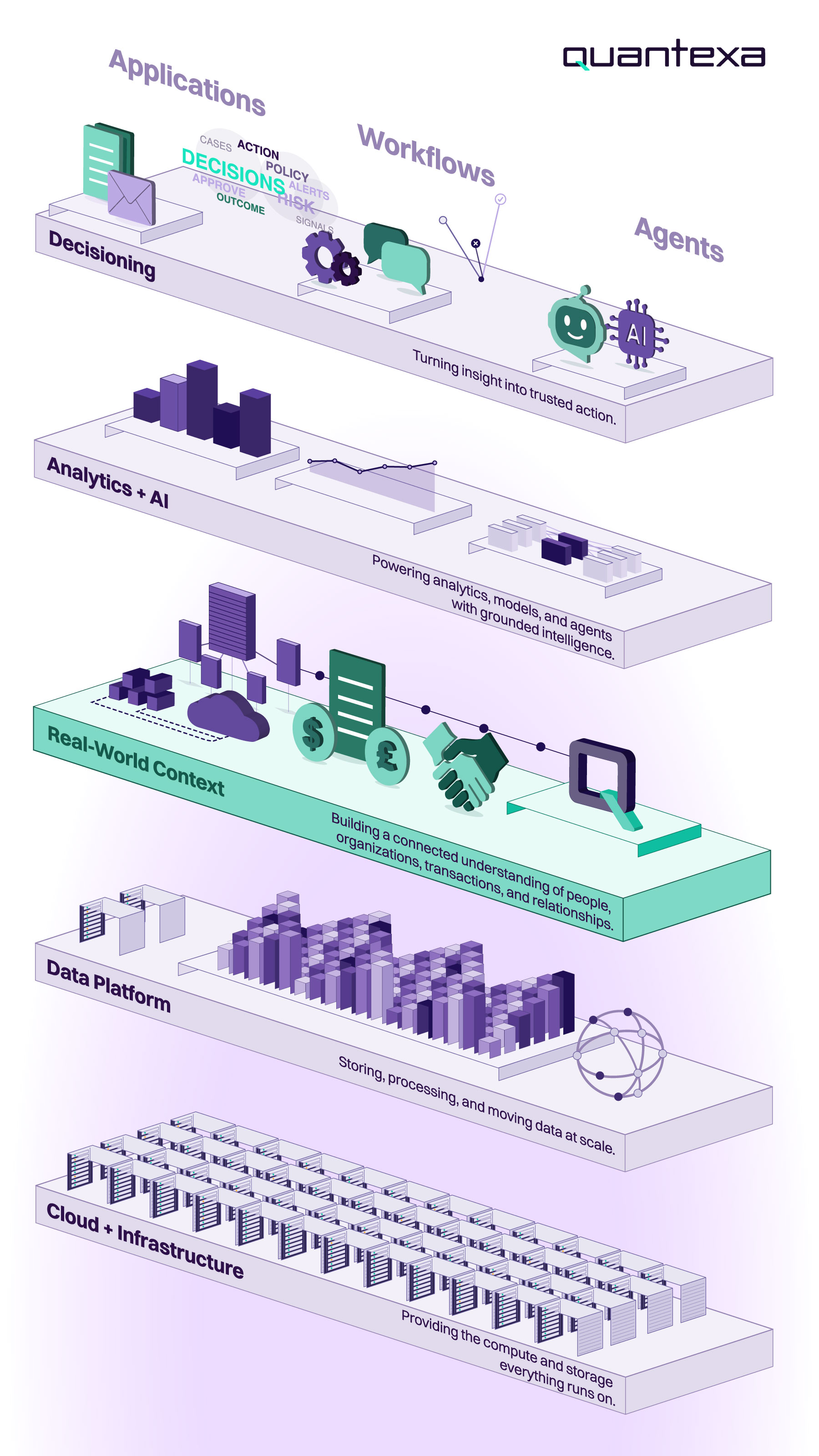
Cloud infrastructure and data platforms are critical foundations of the context layer. They provide the scale, processing power and governance needed to bring enterprise data together and make it available for use. Analytics, AI and operational applications then use that data to generate insights, support decisions and drive action. But without a trusted understanding of the real-world people, organizations and relationships within the data, those decisions are still being made on fragmented and ambiguous information. Without real-world context, the trusted, resolved understanding of who and what your data represents, a context layer is missing a critical piece of the puzzle. That’s the piece Quantexa was built to provide.
Quantexa’s role starts with a problem every large enterprise has, and few can see: the same customer, supplier or citizen exists dozens of times across its systems, under slightly different names, addresses and identifiers, with nothing to say they’re the same entity. The best investigators have always reasoned past this, noticing that “A. Smith” at one address and a phone number surfacing across three “unconnected” accounts are, in fact, the same underlying reality. Entity resolution is that reasoning, at enterprise scale, and it is one of the hardest problems in building a context layer, because real-world data is incomplete, inconsistent, and sometimes deliberately disguised.
We turn fragmented data into real-world context: building a trusted understanding of the people, organizations and relationships it represents, and we do this in some of the world’s most regulated and high-stakes organizations, where incomplete or inaccurate context has serious consequences.
The real-world context Quantexa creates can be written back into the data platform and activated across the enterprise through governed data products. This gives models and analytics a trusted foundation, grounds AI agents in an accurate understanding of the real world, and powers verticalized solutions for complex decision-making across compliance, risk and growth.
Enterprises need both scale and understanding. Cloud infrastructure and data platforms provide the foundation. Quantexa provides the real-world context that makes the data actionable.
The contextual difference
Working across financial services and public sector we have seen first-hand the impact real-world context has on decision making;
Agents grounded in context hallucinate less and deliver a 40% uplift in the quality responses and outcomes.
Investigation times are dropping by up to 80%
Risks and threats are identified 9 to 12 months sooner
Noise is reduced with a 73% improvement in false positive flags
KYC operational costs are falling by 60%.
New prospects are identified and engaged 90% faster.
This is what AI looks like when it actually understands the world it is working in.
We built our entity resolution capability to operate on the scale this problem demands: resolving tens of billions of records across hundreds of millions of customers, including records that are incomplete, inconsistent or intentionally obscured.
Customers did not want a clever algorithm they could not explain to a regulator, a board or an investigator. They wanted confidence, evidence, and control. That inspired us to build for trust as much as for accuracy.
Once records are resolved into single, trusted entities, we connect them through our patented knowledge graph, best understood as a living map of relationships, not a static one. A spreadsheet gives you a fact. A knowledge graph gives you a story: this account, this address, this device, and this business partner belong to the same network, and the pattern is invisible until you can see the connections. That combination, resolving identity and mapping relationships continuously into what we call real-world context, at enterprise scale, with every link traceable back to evidence, is the hard engineering problem we have hardened in production across some of the most demanding environments.
That isn’t the finish line, though. Context has to reason, turning connected entities into scores, alerts and recommendations a person or a model can use, and it must reach action, showing up inside the case management system, the underwriting tool or the agent workflow where a decision gets made, not a dashboard nobody opens. That’s the direction we’ve been building for years, and where most of our new investment is going towards graph that reasons and acts inside the systems our customers already run.
We then help organizations package that real-world context, a living, continuously refreshed representation of the people, organizations and events inside their data, as governed, reusable data products built to be consumed in analytics pipelines, operational applications, and AI agents. Build the context once. Continually refresh it. Reuse it everywhere a decision gets made.
Before “context” was a buzzword
We didn’t arrive here because generative AI made “context” fashionable. Entity resolution and knowledge graphs are entering an entirely new era now, one where the stakes and the possibilities are both higher than they’ve ever been. We’ve been at the frontier of that evolution for ten years, long before anyone was pitching agents, and long before the rest of the market started paying attention.
Our technology has helped banks uncover financial-crime networks hiding behind thousands of accounts, helped insurers link claims, policies, people and assets to catch fraud no single system could see, helped telecoms companies expand their customer offerings and revenues, and helped government agencies build one complete view of a citizen to provide preventative health care, or a stream of public funds, instead of a dozen partial ones.
Consider a child in the National Health System. Their patient record might show routine appointments, a minor A&E visit, a missed vaccination. Nothing that flags concern. Add social data: housing instability, a parent in crisis, school attendance that has quietly collapsed, case notes from a social worker and the picture changes entirely. The child is visible in each of those systems but not understood. Entity resolution and knowledge graphs solve that by connecting the child's identity across clinical, social care, education and benefits records, surfacing a context no single dataset could produce. Patient data tells you what has happened inside the health system. Social service data tells you what is happening in a child's life. Combined into a single trusted view, they give practitioners something they rarely have: the full picture, early enough to matter.
That experience, built in the highest-stakes regulated environments in the world, is why today's AI limitations look so familiar to us. Models stumble when identities are ambiguous. Agents fail when relationships are missing. Automation becomes dangerous when a decision can't be traced back to evidence. These are not new problems. They are the same problems, at a new scale. Context is not a feature you add at the end. It is the foundation that lets AI be trusted in the first place.
"Context is not a feature you add at the end. It is the foundation that lets AI be trusted in the first place."
Trust, governance and sovereignty aren’t features. They’re the foundation.
None of this works if context becomes an unrestricted pool of information. It must be governed by design. Every entity, relationship and recommendation should be explainable: where it came from, how records were connected, which models contributed, and what policy governed who could see it.
That matters more as AI moves from answering questions to acting. An employee might be cleared to view a record an autonomous agent is not authorized to touch. A multinational may process data freely in one jurisdiction and be required to keep it within borders in another. A public agency may need to prove a decision wasn’t just accurate, but lawful, proportionate and free of inappropriate bias.
Trust, governance and data sovereignty cannot be bolted on after AI is built. They must be engineered into the context layer itself. Organizations that get this right are safer, and they can move faster, because they can demonstrate control over what their AI is doing and why.
This is one of the lessons I feel most strongly about now. When governance is treated as a compliance wrapper, it slows everything down. When it’s engineered into the way context is created and used, it becomes the reason people are willing to move faster.
Context looks different depending where you sit
The same context problem shows up differently depending on where you sit. Some are trying to arbitrate between competing versions of truth. Some are trying to make agents useful in production without creating another silo. Some know their models are only as good as the entities underneath them. Lines of business rarely use the words "context layer" at all; they just want to know they're looking at the same customer, claim or payment. And in the public sector, there is no room for abstraction: every decision must be accurate, lawful and explainable to the people affected by it.
The language differs. The pressures differ. The exercise is the same. Pick one consequential decision. Ask what a person or agent would genuinely need to know to decide with confidence. Trace where that context lives, how identity and relationships need to be resolved, what governance applies, and how the result can be reused. That is how organizations move from trusted data to AI people can trust.
The next advantage will be contextual
We’re already living the divide this creates. I see it directly: the banks, insurers, and government agencies pulling ahead right now are not the ones with the most powerful models. They’re the ones that made a trusted, enterprise-wide view of their data a priority years ago, that kept their systems open and extensible rather than locked into one vendor, and that treated transparency as a requirement rather than an afterthought. They were building this advantage before “context” was a category, and the gap between them and everyone else is starting to compound.
Most organizations will soon have access to similar foundation models, similar cloud infrastructure, and similar copilots. Those have become table stakes fast. The advantage that’s left can’t be bought and is impossible to copy. It’s the context that’s unique to your organization. But the quality of it is something that needs intentional focus: how trustworthy, how transparent, how current, and how deeply it’s embedded into every decision is what matters.
"The advantage that's left can't be bought and is impossible to copy. It's the context that's unique to your organization."
That is the work Quantexa has been doing since before this conversation existed. We don’t own the context layer, but we are one of its most foundational pieces: resolving fragmented data into trusted, real-world entities, connecting the relationships around them, governing how that intelligence is used, and making it available across the enterprise, whichever platforms or agents that enterprise runs. It’s work we’ve hardened in production, in regulated markets, where trust is not a slogan, and mistakes have consequences.
So here is the one question I would leave every leader building an AI stack with: can you say, with evidence, who and what your data represents, and what it’s connected to? If you can’t answer that cleanly, you’re missing a critical piece of your context layer, the real-world, resolved, governed piece, and that is exactly the piece we’ve spent a decade building. If you can, context stops being another layer in architecture. It becomes the foundation for decisions people can explain, actions they can trust, and an advantage competitors cannot easily replicate.