Why AI Agents Need a Context Layer and What Belongs Inside It
Gartner® identifies the absence of a dedicated context layer as a major contributor to the value gap between AI investments and outcomes. Find out what they are and why real-world context is necessary to drive reliable and trusted decisions from AI agents.
Why AI Agents Need a Context Layer and What Belongs Inside It
Gartner® identifies the absence of a dedicated context layer as a major contributor to the value gap between AI investments and outcomes. Find out what they are and why real-world context is necessary to drive reliable and trusted decisions from AI agents.




While nine out of ten organizations say they already use AI regularly, most are still experimenting or piloting, and nearly two-thirds have not begun scaling AI across the enterprise, according to McKinsey. Ambition is running well ahead of that. In the Gartner 2026 CIO and Technology Executive Survey, “42% of respondents reported their enterprise would deploy AI agents by the end of 2026,” which, from our perspective, means agents will be deployed in workflows where the output carries real consequences. What we’ve seen so far is that many enterprises are yet to see tangible value from their AI investments.
In the latest Gartner report, The 3 Core Components of the Context Layer for AI Agents, Gartner identifies the absence of a dedicated context layer as a major contributor to the value gap, since organizations that adopt AI without strong data and governance foundations get unpredictable results from their agents regardless of how capable the underlying model is.
That matches what we see. The push to scale AI, for efficiency and for growth, brought the absence of context to the surface as the missing piece for trustworthy AI-enabled decisions. Whether a person or an AI-enabled system reaches the decision, context defines its quality. Connecting data and surfacing the hidden relationships inside it is what we have spent the last decade helping organizations do.
What is a context layer?
Gartner defines it:
The context layer acts as a dedicated architectural component that curates, integrates, and delivers the information required by AI agents. It provides dynamic and persistent background knowledge that enables AI agents to interpret inputs, make informed decisions, and act in alignment with business objectives.
A context layer can’t be bought in its entirety; the layer must be engineered from services, capabilities, and custom modeling that turn an organization’s tacit knowledge into machine-readable form. And the responsibility sits with the architecture and data teams, which is a reframe for anyone assuming the AI team handles it alongside model selection.
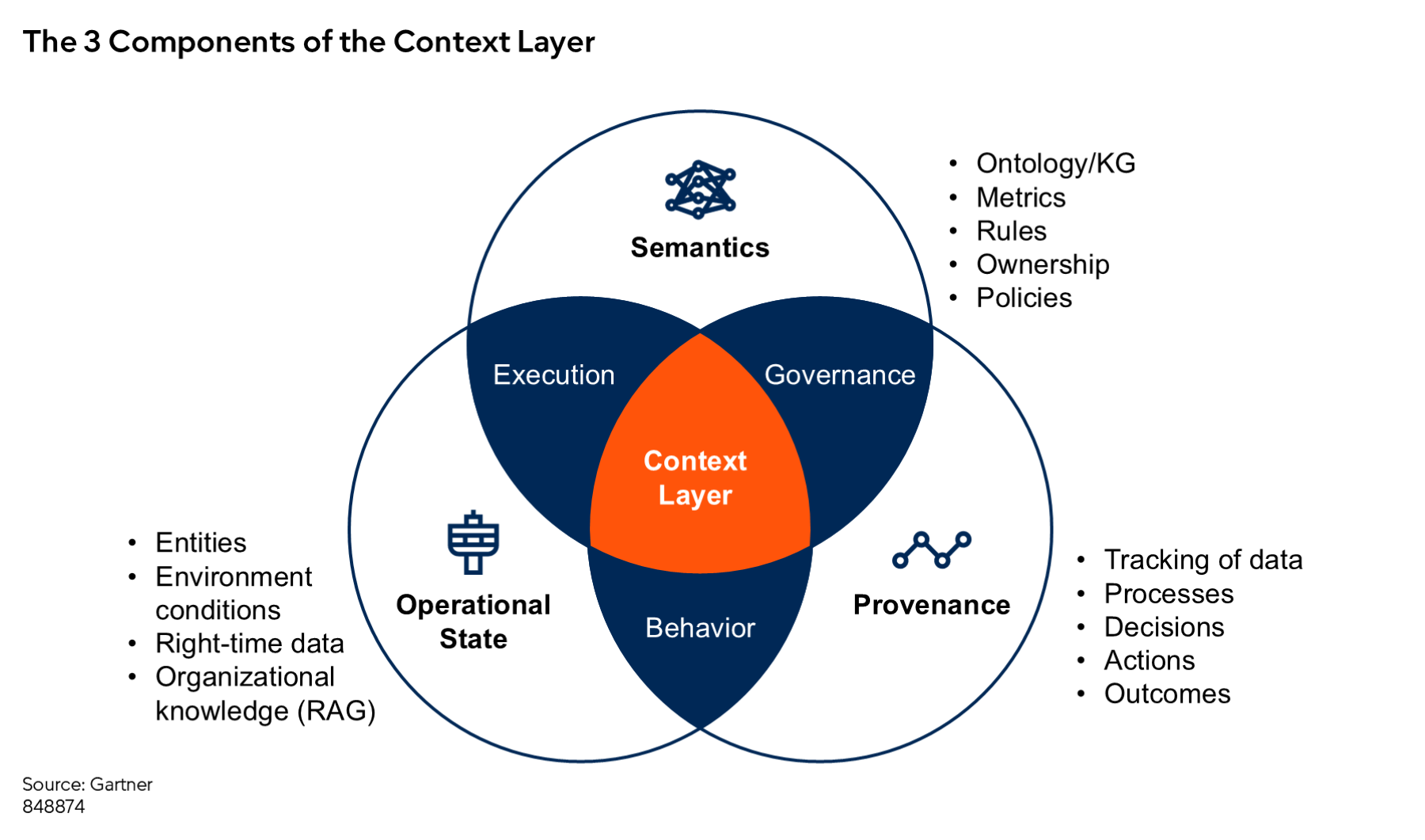
Gartner sets out three components that a robust context layer needs to bring together:
Semantics. Agents interpret and organize information by meaning and relationship. Ontologies and knowledge graphs connect data, metrics, rules, ownership, and policies so an agent can reason the way a domain expert would. Organizations that implement semantic modeling, such as taxonomies and ontologies, are up to 2.2 times more likely to achieve high effectiveness in data engineering practices supporting AI use cases compared to those that do not, yet only 44% have implemented these.
Operational state. Agents need right-time access to the current status of business entities, processes, and conditions, so they are not working from stale information. Only 30% of data and analytics solutions currently leverage real-time data streaming and event-driven analytics, although real-time analytics can drive up to 35% higher business value. Gartner recommends event-driven platforms and protocols such as the Model Context Protocol (MCP) to reduce retrieval latency.
Provenance. Provenance tracks data lineage, decisions, actions, outcomes, and feedback across the agent lifecycle, which supports auditability and regulatory compliance. 74% of organizations recognize that data governance tools help operationalize AI governance, underscoring the need for mechanisms to manage and trace AI actions.
 Real-world context is what makes your data decision-ready
Our view, from a decade of building trusted contextual data foundations with customers, is that AI agents, especially those in multi-agent ecosystems, need real-world context to understand and connect what matters to drive better decisions: Who is involved, how are they connected, what is known, and why does it matter?
Real-world context provides an understanding of who someone really is once their records and relationships are connected across the enterprise, and what those connections imply for the decision at hand. In our opinion, it improves each of the three components set out by Gartner.
Semantics. Semantics tells a system what its fields and relationships mean, that a person can own a company, that a company can hold an account. Real-world context tells it which specific person, which specific company, and which of those relationships exist in this case.
Operational state. Real-time data starts paying off once it is attached to a resolved, trusted view of the entities involved, because streaming live data over fragmented identities moves noise around faster. Resolve identity first, and the speed of the flow above it matters.
Provenance. Governance handled as a compliance wrapper at the end slows everything down, and governance engineered into how context is created and used becomes the reason teams move faster. Traceability from data point to outcome is what makes an AI-assisted action defensible to a regulator or an auditor.
Building a context layer in practice
Gartner advises against attempting a comprehensive context layer in a single project and recommends starting with high-value use cases, proving the outcomes and then expanding. It projects that by 2027, organizations prioritizing semantics in AI-ready data will increase agentic AI accuracy by up to 80% and reduce costs by up to 60%.
We agree that no single vendor provides a context layer, and any company that tells you otherwise is oversimplifying. It is a collection of systems and capabilities working together, entity resolution, semantics, ontologies, and knowledge graphs, some bought and some built, spanning the enterprise stack.
Our own part in that is specific. Decisions are still made on fragmented and ambiguous information when there is no trusted understanding of the real-world people, organizations, and relationships inside the data. The same customer, supplier, or citizen exists dozens of times across an enterprise’s systems under slightly different names and identifiers, with nothing to say they are the same entity. Entity resolution establishes that they are, at enterprise scale, and it is one of the harder problems in building a context layer, because real-world data is incomplete, inconsistent, and sometimes deliberately disguised. We do this in some of the world’s most regulated organizations, and the context we create can be written back into the data platform and used enterprise-wide.
The sequence we use with customers starts from a decision where better context would change the outcome, then works backward. Connect the data, resolve the entities, define business meaning, map the real-world relationships, add decision context, make it available to people and agents, and keep it current.
Modern models and agentic tooling contribute much of the speed on their own, and context is what makes that speed safe to rely on. Where our customers ground agents in resolved, connected context, they see a 40% uplift in quality responses, investigation times falling by up to 80%, risks surfacing nine to 12 months sooner, know your customer (KYC) costs dropping by 60%, and new prospects engaged 90% faster.
Find out more
Gartner report sets out recommended actions for each component, including how to sequence the build. Complimentary access is available for a limited time. Download the Gartner research.
For more on building real-world context, read our guide, What is a Context Layer and Why Does it Matter for Enterprise Data?
Gartner, The 3 Core Components of the Context Layer for AI Agents, Andrés García-Rodeja, Michael Gonzales, Christopher Long, Afraz Jaffri, 11 March 2026.
Gartner is a trademark of Gartner, Inc. and/or its affiliates.