When AML Decisions Lack Context
When correspondent banks lack visibility into the true networks behind cross-border payments, every AML-related decision carries uncertainty. Without trusted context, false positives rise, confidence erodes, and AI falls short, leaving real risk harder to detect when it matters most.p
6 trillion
Illicit financial flows are projected to hit $4.5 trillion to $6 trillion by 2030.
Source: Secretariat
70%
of executives expect financial crime risk to increase in 2025.
Source: Kroll
HOW WE SOLVE IT
Decision Intelligence for Correspondent Banking AML

Detect real risk, reduce noise
Configurable, relationship-focused scoring, facilitates more meaningful alerts, cuts false positives and improves escalation quality.
Surface hidden relationships
Advanced entity resolution and network generation reveal end parties, intermediaries, and payment chains.
Power meaningful monitoring, detection and investigations
Connected intelligence powers more precise scoring, higherquality alerts, and contextual monitoring that transforms detection, triage, and investigations.
Accelerate AML operations in correspondent banks with AI
A contextual foundation powers AI-assisted triage and investigation workflows, driving faster reviews, clearer, more trustworthy decisions, and better regulatory outcomes.
THE IMPACT
What we have achieved
in investigation time (at scale)
in false positives
sent for further investigation
See it in action
Take a self-guided tour of our platform to see how financial crime risk is detected in correspondent banking. Follow the prompts to explore how connected data and network analytics uncover hidden connections across complex payment flows, counterparties, and relationships that traditional transaction monitoring misses.
We help you bring context to Correspondent Banking AML compliance
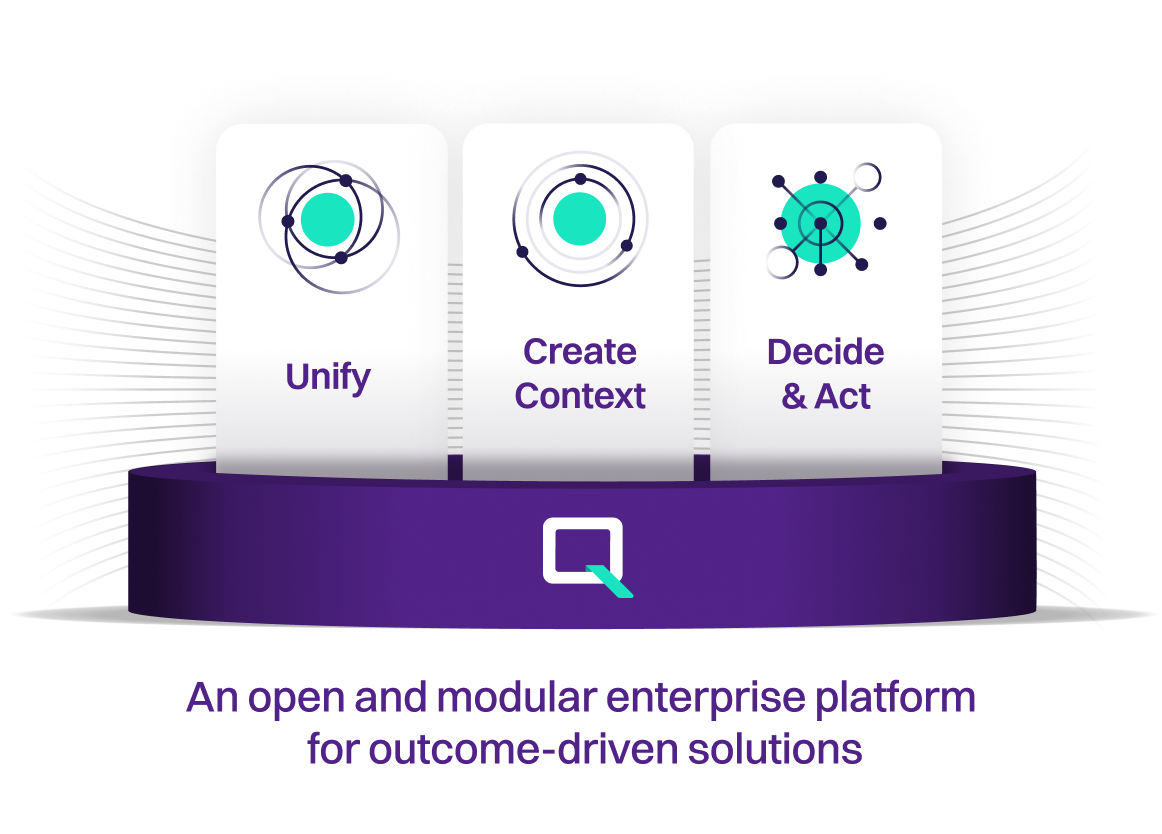
Decision Intelligence solutions built on our platform
Data Modernization
Build a trusted data foundation to deliver context for decision-making.
Learn moreCustomer Intelligence
Enhance customer experience and accelerate revenue growth with a 360-degree connected view of customers.
Learn moreKnow Your Customer
Detect risk in real time to identify unknown risks and deliver more accurate risk ratings.
Learn moreRisk Management
Revolutionize risk assessment with a holistic understanding of borrowers, their counterparties and relationships.
Learn moreFraud and Security
Uncover hidden fraud risks with a contextual approach to detection and prevention.
Learn moreFinancial Crime
Reduce false positives and focus on real risk by modernizing your AML monitoring, detection, and investigation.
Learn moreFAQs
What is the difference between traditional Transaction Monitoring and Contextual Monitoring?
Rules-based transaction monitoring systems have several limitations and challenges, which have historically hindered their effectiveness in detecting and preventing financial crimes.
For example, the rules and thresholds need to be manually created and updated, making the system less adaptable to evolving and emerging threats. Similarly, rules-based systems also typically analyze individual transactions in isolation and may not provide a comprehensive view of customer and counterparty behavior or relationships. They may miss the connections between seemingly unrelated transactions or accounts, which can be crucial in identifying more complex fraud networks or money laundering schemes.
In contrast, by combining multiple internal and external datasets all at once, Contextual Monitoring transforms the view of risk to a gain clearer understanding of customers, counterparties, their relationships, and behaviors in real time. Using advanced Entity Resolution and network generation techniques, Contextual Monitoring focuses on holistic relationships rather than transaction risk in isolation.
This added context helps to identify hidden risk and generates fewer, more accurate alerts. Institutions can reduce rising compliance and operational costs and conduct more effective and efficient intelligence-driven risk processes without replacing existing systems.
How can we accelerate the investigations process?
Turning data into intelligence is imperative for reducing manual processes, identifying critical connections and breaking down silos between teams. For AML investigations, shifting to an intelligence-led approach goes beyond a single event, relationship or activity enabling a more holistic understanding of customers, employees, counterparties and their related risk. With the broad capabilities of Quantexa’s platform, intelligence officers have a powerful tool that can run different analytical tasks, covering a risk-based approach and integrating third-party data and external sources for deeper investigation. Unlike traditional systems, Quantexa's AML software visualizes hidden connections through additional context.
How can banks navigate AML complexities?
Evolving AML intricacies and typologies driven by multiple channels, lines of business and products have driven major challenges in financial services. With Quantexa's Decision Intelligence platform, Quantexa's AML software can transform a banks approach to financial crime compliance. Improving risk coverage, identifying complex typologies, pinpointing real risk, reducing false positive and uplifting efficiencies.