Four Decades of Passion, Collaboration and Mentorship in the Fight Against Financial Crime
What does it take to turn a hunch about suspicious transactions into an industry-wide playbook? John Byrne explains, drawing on four decades spent building and defending the tools AML professionals rely on today.
Four Decades of Passion, Collaboration and Mentorship in the Fight Against Financial Crime
What does it take to turn a hunch about suspicious transactions into an industry-wide playbook? John Byrne explains, drawing on four decades spent building and defending the tools AML professionals rely on today.



A decade ago, a handful of front-line bank employees noticed something troubling in their transaction data. There were patterns that pointed to human trafficking (HT) operations running through cities from Columbus to San Antonio. They took it to their anti-money laundering (AML) leaders, who took it to John Byrne, then an executive vice president at ACAMS. Six weeks later, investigators from the FBI, the Department of Homeland Security and several banks had built the first public red flags for spotting HT, indicators that are still used across the industry today.
For Byrne, who has spent more than 40 years in anti-financial crime (AFC), that project is one of the clearest examples of what the work is for. Suspicious activity reports (SARs) and money laundering statutes can read as abstractions on paper, but they exist to interrupt real harm to real people, a point Byrne returns to often when he talks about four decades of policy work, advocacy and mentorship.
What “follow the money” covers today
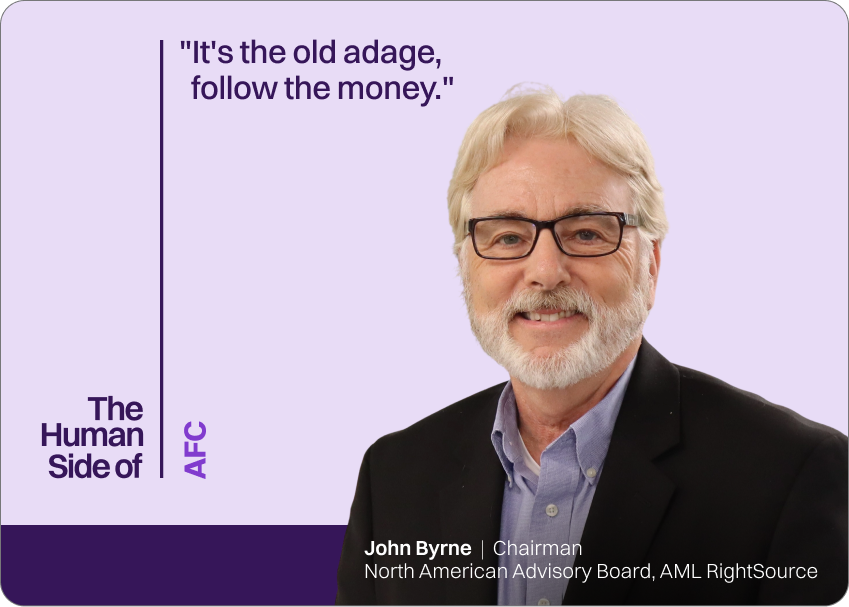
Byrne’s shorthand for his work, the one he gives when explaining his job on CNN or Good Morning America, is simple, “It’s the old adage, follow the money.” Every crime with a financial component leaves a trail, he says, and the job of an AF professional is to find that trail and act on it, ideally before the harm occurs rather than after.
That scope has widened since Byrne entered the field in the early 1980s. “It was all just drug trafficking in the eighties and nineties,” he says. Other crimes existed, but the industry’s focus didn’t broaden until after September 11, when tracking terrorist financing pushed AML programs to look far beyond narcotics. Today the list includes human and wildlife trafficking, elder abuse, cybercrime and cryptocurrency-related crime, and Byrne points to artificial intelligence and other tech tools -- as newer forces doing the most to reshape how the industry monitors financial crime now.
He also credits examiners with understanding the need to get more knowledgeable. Early in his career, Byrne says regulators were “still finding their way,” which led to overly literal, checklist-driven reviews. That’s improved, even if the “check the box” mentality still shows up more than he’d like.
The infrastructure Byrne helped build
Much of what today’s AML professionals take for granted, Byrne had a hand in creating. When the Money Laundering Control Act passed in 1986, he spent a year traveling to 15 or 16 U.S. cities explaining the new rules to bankers. He later proposed the framework that became the Bank Secrecy Act (BSA) Advisory Group, drawing on other government roundtables, and helped run its first 25 meetings.
His most consequential contribution may be the civil safe harbor, enacted in 1992, which protects financial institutions from litigation when they file SARs or share information with law enforcement in good faith. Without it, Byrne argues, banks would hesitate or simply not file the volume of reports, and the detail within them, that law enforcement depends on. “That has held up through court challenges since we did it back in 1992,” he says.
After September 11, Byrne, then with the ABA, worked to connect member banks with law enforcement quickly, partnering with his longtime friend Dennis Lormel, who ran the FBI’s first terrorist financing operations section. That same instinct for building bridges between the public and private sectors led him, years later, to help start the AML Partnership Forum in Washington, D.C., a two-day conversation between bankers and law enforcement now heading into its sixth year. “Those things didn’t necessarily happen enough before,” Byrne says. “Now I think both sides really embrace that, and I think that’s a big change.”

Where information sharing still falls short
Not everything Byrne helped build has worked as intended, and he’s candid about the gaps. Sections 314(a) and 314(b) of the USA PATRIOT Act were both designed to improve information sharing: 314(a) lets FinCEN pass law enforcement requests on to banks, while 314(b) allows institutions to share information with each other on matters related to money laundering. Byrne says 314(a) “should have been a two-way street” rather than the one-directional process it became, and that bank lawyers “overreacted to the limitation” in 314(b), reading it narrowly and excluding fraud-related sharing that he believes was meant to be covered and now is through the recent FinCEN FAQs
The other persistent gap, in Byrne’s view, is SAR feedback. He rejects the idea that filings disappear into a void. “All SARs get reviewed at some point, and to suggest otherwise means you’re not really paying attention,” he says. But he agrees the feedback loop could be far better, and argues the industry has never seriously attempted to fix it. His proposal is a commission of bankers, investigators and regulators in the same room, designing a system everyone would actually find valuable. “We talk about it all the time,” he says, “but we sort of talk past each other.”
The unintended cost of derisking
One issue that has become a defining focus for Byrne in recent years is derisking: banks exiting or avoiding relationships with charities, NGOs and other organizations working in conflict zones because of regulatory concern. Byrne says he didn’t fully grasp the consequences until he began working with the World Bank and the Charity and Security Network, which surfaces cases of humanitarian groups losing the banking access they need to move medical supplies, water and funds into dangerous places.
Progress has been slow but real, he says. The Financial Action Task Force’s outgoing president, whose two-year term just ended, spearheaded recommendations calling for humanitarian exemptions and warning against inadvertently harming aid organizations. “It’s not remotely perfect,” Byrne says, “but there’s more inclusion, no question. Outreach has made sense, communication has made sense, and spotlighting has made sense.”
What separates practitioners who stay from those who leave
Across hundreds of conversations with AML practitioners, Byrne says one quality consistently separates those who stay in the field from those who burn out. “Passion,” he says. “That’s what makes people different.” He points to curiosity too and a genuine interest in understanding new tools, techniques and typologies as they emerge as the trait that keeps people from burning out.
That belief shapes how he mentors students at George Mason University, where he teaches a graduate class on money laundering, corruption and terrorism and brings in practitioners to walk through real cases. His advice to them is consistent, that the field now offers far more paths than it did when he started, whether in policy, operations or technology, and the work carries real consequences. He’s honest with them, too, about the current difficulties he sees navigating the current Adminstration’s approach to financial crime.
A closing thought
Byrne also credits his staying power to a full life outside of work, He spent 22 years at the American Bankers Association, which had a family-oriented culture that let him coach his four (now adult) children’s sports teams and serve as PTA president, and three and a half miles run every single day for 30 years, a streak he finally ended on his own terms in 2024.
More than four decades after entering a field that didn’t yet have a name, Byrne still measures the work by the same standard: getting information into the hands of people who can act on it, before the crime happens if possible, and after it if not. It’s a standard that outlasts any single law or title, built instead on practitioners willing to notice a pattern, ask a question and follow it through — the same instinct that turned a handful of bankers’ suspicions into a set of red flags the whole industry now relies on.