Using Empathy and Education to Help Drive AFC Excellence
Fulton Bank's Jamie Thomas explains how empathy and education turned turn the AML compliance grind into something far more human.
Using Empathy and Education to Help Drive AFC Excellence
Fulton Bank's Jamie Thomas explains how empathy and education turned turn the AML compliance grind into something far more human.



Anyone considering a career in anti-money laundering (AML) or Bank Secrecy Act (BSA) compliance should know from the outset that the path is “not for the faint of heart,” says veteran practitioner Jamie Thomas. She describes the profession as “grueling”, and, at times, even “soul-sucking.” It doesn’t help, she adds, that even with a strong financial crime compliance program, the best regulators and examiners can say is that the efforts are “satisfactory.”
In other words, being labeled “just good enough” is the high mark compliance teams are working toward. That reality could lead some practitioners to operate like “robots,” simply pushing through by clearing the work, meeting the standard, and moving on to the next demand, in a field where scrutiny and pressure are unrelenting.
Thomas, who is vice president and deputy BSA director at Fulton Bank, a regional bank headquartered in Lancaster, Pennsylvania. was compelled to rethink that approach..
What changed the game for Thomas and ultimately for her team, was a conscious decision to step back and allow empathy to play a bigger role in her everyday work. Empathy is central to her leadership approach. “I want my team to feel human,” Thomas says. “And I want them to see me as a human. Tapping into the human side and allowing their emotions to be valid in their work has produced a stronger team. I know it’s made me a better employee, and I hope, a better leader, too.”
A haunting memory and an enduring reminder of why the work matters
In the early 2000s, [JK1] when she was living in South Korea as a college student, Thomas had an experience that was an early lesson on the importance of empathy. She noticed a disturbing pattern of activity across many of the local bars and restaurants. Young girls, many of them from Russia, were dancing on stage and performing very badly. That wasn’t because they lacked talent, as Thomas initially thought. As she watched them more closely, she realized they were stumbling around because they were drugged.
Years later, after entering the world of BSA compliance, the meaning of that experience came back to Thomas in what she describes as a “lightning bolt of connection.” She understood that those girls were also being trafficked and that realization immediately deepened her commitment to the work. She says the memory remains vivid and keeps her “fired up” to do her part to help people in similar situations.
What Thomas witnessed in South Korea is also a lasting reminder that anti-financial crime (AFC) work is never just about patterns and transactions. What looks ordinary on paper can be connected to something much darker affecting the lives of real people. Thomas says this is why she remains committed to understanding financial crime and not just how it happens, but why.
Any community can be fertile ground for financial crime
One area that has become a focal point for Thomas over her past 12 years at Fulton Bank is sanctions risk. She says she was initially surprised to find a mid-atlantic regional bank serving many rural communities would carry the level of sanctions risk she’s encountered. But the risk is now abundantly clear to her.
Thomas explains that even in smaller markets, businesses may still operate internationally, rely on suppliers abroad and move payments across borders. What makes sanctions risk easy to miss is that it can be concealed within activity that appears entirely ordinary on the surface, such as an order for parts or a payment to a supplier based outside the United States.
That, Thomas suggests, is part of what makes smaller businesses, rural communities and regional markets easier to underestimate and easier to target. When businesses don’t fully understand complex sanctions or AML requirements, bad actors may see an opening. This is part of a larger lesson about AFC work at a regional bank, according to Thomas. Financial crime is global in its reach, and local activity can connect quickly to something much bigger. Effective compliance depends on people who know how to recognize those links so they aren’t overlooked or dismissed.
Building range and resilience across the compliance function
At Fulton Bank, Thomas is working to build the kind of AFC team people can stay and grow with for the long term. She wants a team where people can talk through challenges, ask for help and admit when the work is getting heavy without feeling they’ve somehow fallen short.
That same mindset guides how Thomas thinks about hiring and developing talent. While technical knowledge can be taught, qualities such as independent thinking, problem-solving, analytical ability and a willingness to dig below the surface are much harder to instill. Once people are on her team, Thomas is intentional about giving them exposure across alert types, Currency Transaction Reports (CTRs), investigations, Office of Foreign Assets Control (OFAC)-related work and more so they can understand not just one workflow, but how all the pieces fit together,
Thomas says her team also needs to understand how data moves, how controls operate behind the scenes, and where breakdowns can occur. Better tools have helped reduce fragmentation and make information easier to access and review. But for Thomas, that progress only matters if her people still understand the systems and workflows behind the output. One question her team always asks when implementing something new is simple: If this stops working, what do we do?
She takes the same view of artificial intelligence (AI). Thomas has seen her team achieve “small wins” already in using AI capabilities for annual risk assessments, checking writing, and summarizing large datasets or alerts that might otherwise take more time to review. But she is clear that AI should remain a secondary tool, not the source of the team’s thinking.
“No matter what technology they use, they still need to be able to say, ‘I know this customer, and I know what they’re doing,’ and understand everything surrounding that—not just spit out facts,” says Thomas.
Making the AFC mission a shared priority
Thomas says she would like to change how financial crime compliance functions are typically viewed inside a bank and also see those functions operate more transparently and collaboratively. “BSA is very greedy when it comes to information,” she explains, noting that teams are constantly asking for documents, details, follow-up and explanation, but too often give little back. That can leave compliance functions isolated, misunderstood and seen as the “department of no.”
At Fulton Bank, Thomas is focused on providing more reciprocity, education and context so people can better understand why certain patterns matter and how their own work connects to the AFC mission. Frontline staff are bringing issues to the BSA team sooner. They’re seeing financial crime risk not as an abstract compliance matter, but something that can surface in ordinary customer activity and seemingly innocent business relationships.
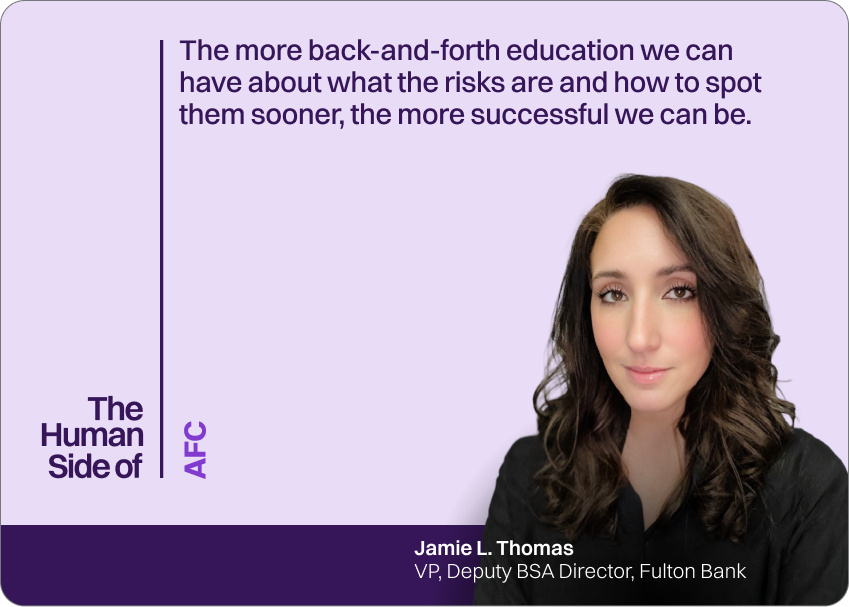
“The more back-and-forth education we can have about what the risks are and how to spot them sooner, the more successful we can be,” Thomas says. “There may be things we can’t share with people outside of our function, but there is still much we can offer to help people understand what we do, why it matters, and the role they can play in helping us combat financial crime.”