Reading the World Through the Markets, and Building Capacity in the Fight Against Financial Crime
Max Lerner, Global Head of Sanctions at State Street, sees AFC as a people challenge first. Technology helps, but judgment, relationships and knowing the business are what find the next risk.
Reading the World Through the Markets, and Building Capacity in the Fight Against Financial Crime
Max Lerner, Global Head of Sanctions at State Street, sees AFC as a people challenge first. Technology helps, but judgment, relationships and knowing the business are what find the next risk.


Disclaimer: The views expressed by Max Lerner herein do not necessarily represent any past or current employer.
For Max Lerner, giving back to the AFC community extends well beyond his day job. On a Financial Services Volunteer Corps trip to Tajikistan, he met a handful of people trying to build an AFC program from scratch. He has seen the same thing on volunteer trips to Cyprus and Montenegro — countries where sanctions and AML compliance isn't just a small field. That reality has shaped how Lerner thinks about capacity building: less a technology problem than a people one.
Lerner is currently a Managing Director and Global Head of Sanctions, Anti-Boycott, and Anti-Bribery and Corruption Compliance at State Street, — but the instinct that drives his work traces back to a political science and history major at Colgate. It was there Lerner grew to believed financial markets are one of the clearest windows onto geopolitics there is. "You can see geopolitical stability or lack thereof," he says. "You can see whether that impacts pricing of crops. You can see where economies are moving, where trends are creating demand or taking away demand." He left behind a first-year associate's diet of ISDAs and credit agreements and moved into AFC work as a wave of U.S. enforcement in the early 2000s pushed banks to build out their compliance functions in earnest.
The weight behind a sanctioned name
Not every case Lerner handles is about market infrastructure or screening logic. He has worked licensing requests where the person on the other end was in a hostage situation, or goods were stuck at a border while a family needed food or shelter. "It puts a very real impact that somebody needs to be safe, get food, get shelter," he says, "and the fact that I can do this from a relatively safe position makes it all the more important that when we're trying to execute these programs, we're doing so also with that humanitarian aspect in mind, that we want to help the people who are not intended to be hurt by these programs."
That same weight lands differently inside a custodian bank, where the risk rarely announces itself as clearly.

Sanctions compliance inside a custodian bank
Custody work carries a different kind of sanctions risk than the wire transfers and account screening most people associate with bank compliance. Institutional clients are rarely sanctioned parties themselves, but the securities moving through the business often are. That became especially true as sanctions against Russia and China expanded between 2018 and 2020, pushing State Street to track sanctioned securities trading on secondary markets around the world, not just in the U.S. The U.S. tends to restrict secondary market trading in sanctioned securities, while Europe leans more toward primary market and dividend restrictions. His answer has been to treat benchmarking as core infrastructure, putting his team on major industry groups where custodian banks compare notes on emerging problems from different angles. That shared view sharpens judgment and helps the industry present a consistent message to regulators like OFAC. It mattered enormously in the early days of the Russia sanctions, when the rules seemed to change daily.
Getting ahead of the next sanctions list
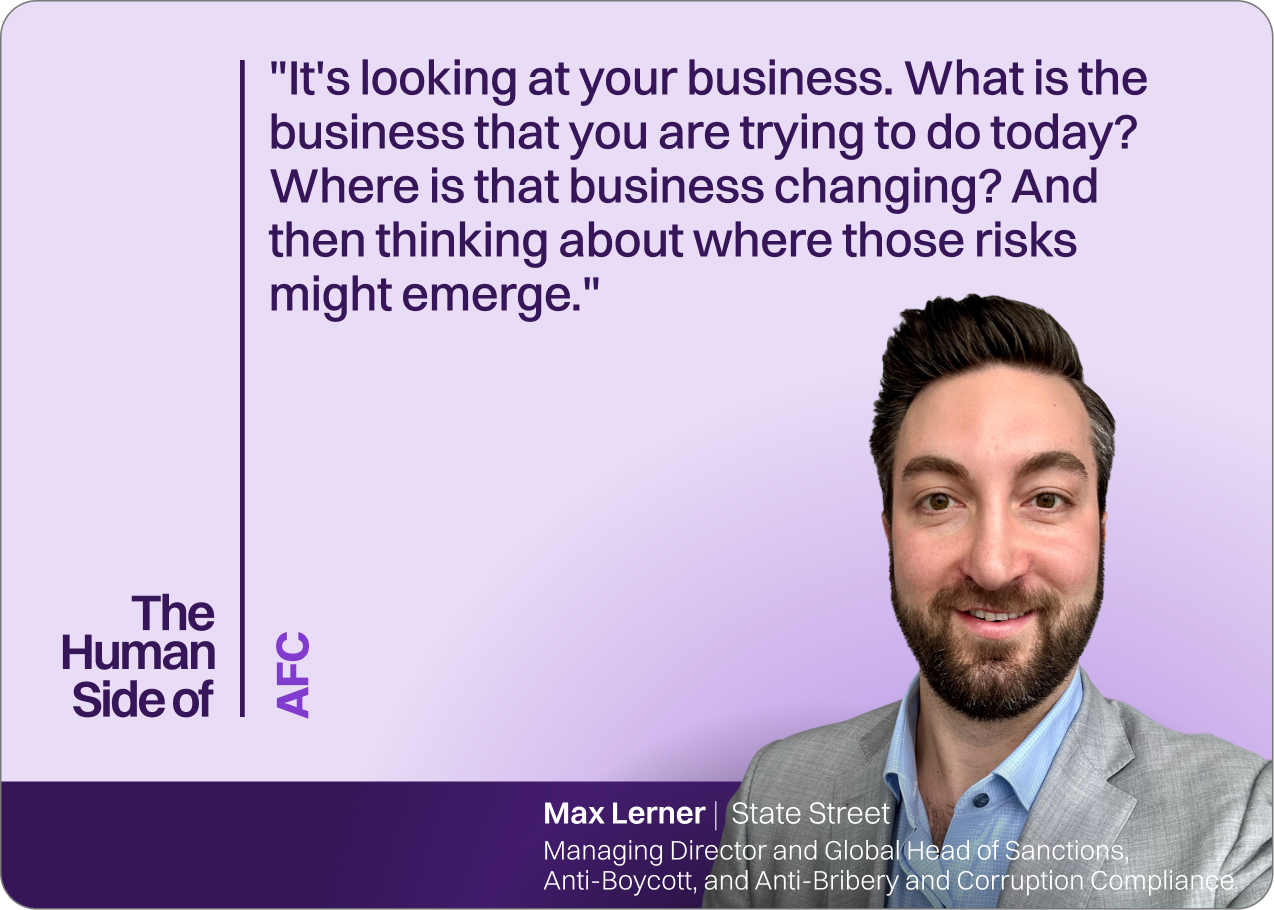
No sanctions program is ever purely proactive, Lerner admits. What separates a mature program, in his view, is treating the business itself — rather than the sanctions list — as the object of analysis. "You are now analyzing your sanctions risk [and] not actually looking at sanctions," he says. "It's looking at your business. What is the business that you are trying to do today? Where is that business changing? And where might those risks emerge?" It's the advice he gives most often to younger professionals: learn the business you're meant to advise, because that's what tells you where the next risk will surface.
AI fits into that picture as a tool along a spectrum, from simple automation to more agentic systems. He grows more cautious the further a use case drifts from well-defined problems like basic name screening into messier territory — corporate names, option strings — where the underlying models are less mature. He believes its real value is freeing people to focus on the judgment that still can't be automated. "Humans still make the best risk decisions when they can bring all that together," he says, "because a lot of that risk decision is going to be getting to know your business , and balancing the demands of the business versus the demands of risk mitigation."
Capacity building, at home and abroad
The Financial Services Volunteer Corps was established after World War II to help countries build the financial infrastructure to become viable U.S. trading partners. The economic incentive is that strong AML and sanctions programs increasingly determine whether a country lands on FATF's grey or black list, and with it, whether banks are willing to do business there at all. But the reward Lerner describes is more personal. "It's building not just the technology, the cool AI, or the automation process, but building the people knowledge," he says. "At the end of the day, it's still all about relationships and about people engagement."
As chair of the Association of Global Custodians' AML and Sanctions Committee for five years, Lerner has watched informal benchmarking become something closer to infrastructure, with member firms meeting monthly to compare notes rather than making the same case to OFAC ten separate times. "I've seen firsthand hundreds of examples where that partnership, that engagement, has allowed each firm, in their own risk-determined way, to make better decisions because we can take in all that information."
What keeps people in the field
Burnout is a real risk in work defined by constant change and repetitive daily tasks. Lerner's approach starts by asking why someone wants to be in this field in the first place. Whether they're drawn to the finance side, to identifying bad actors, or to something else entirely, he believes that answer is what will sustain them. For his own teams, sharing wins, a bad actor identified, a SAR that led somewhere, keeps the work feeling bigger than clearing an alert. He has also learned that a good manager's job is knowing where a person will actually thrive. "Figuring out how someone can succeed and how that person can be in the right role to succeed...that's one of the best things you can do as a manager."
Hope, and the one thing he'd change
However politicized individual sanctions programs get, Lerner finds hope in broad global agreement that no one wants to do business with terrorists or human traffickers. His concern is that, as sanctions have proven effective, governments have kept expanding the tools. Lerner worries that a more capable sanctions regime is also an easier one to deploy, with consequences that reach well past the intended target. If he could change one thing, he would focus the industry on how firms put risk analysis in front of the people who need it, rather than on generating more of it. He is candid there is no easy fix. "There's no simple answer and, unfortunately, I can’tsnap-my-fingers-and-make-it-all-better."
Fighting bad guys and keeping communities safe
At home, Lerner's two young sons have their own theory about what he does all day, helped along by a recent office visit and, by design, plenty of ice cream. "I fight bad guys," he tells them, so that "nobody is doing bad things in our communities." It is a plain enough answer, but it points to something that has shaped Lerner's career. For all the talk of sanctions, screening, and compliance, he has never lost sight of the people affected by those decisions, from families caught at borders to countries working to move off international watchlists.