


Key takeaways
 AI-ready data gives a model or agent reliable background information to support a task or decision. This requires accurate, relevant data that’s available on request, with clear controls over how it can be used.
 - When data is not AI-ready, it may be incomplete, outdated, biased, or fragmented.
- One of the most demanding parts of AI readiness is resolving fragmented records into accurate entities and building a contextual view to make sense of them.
- No dataset is universally AI-ready. Its quality, freshness, and controls must be appropriate for the task, particularly where AI can take action or directly affect a customer. For example, an internal copilot summarizing policy documents has different requirements from an agent authorized to block a payment.
- An AI-ready foundation makes trusted data securely available to AI systems across the organization. It should support explainability at the level of an individual outcome and accommodate further use cases as adoption grows.
AI-ready data is data prepared and placed in context so an AI system can use it reliably for a specific task — accurate, current, governed, and resolved into real-world entities. What counts as ready depends on the task. This guide is for data and IT teams, and at Quantexa we deliver the trusted context AI needs wherever it informs a decision.
What is AI-ready data?
AI-ready data has been prepared and placed in context so that an AI system can use it reliably for a defined task or decision. What counts as AI-ready depends on the task. In enterprise use cases, data needs to do more than meet quality standards. It must establish who or what is involved and connect the evidence relevant to the decision.
Consider an AI system assessing a new bank customer. If two people with the same name are mistakenly treated as one entity, an applicant could inherit someone else’s risk history and be refused credit on the wrong evidence.
When AI can act on its outputs, what was once a data quality issue can quickly become a customer outcome. Bias, gaps, and errors in the underlying data can then affect decisions at scale.
Reliable AI therefore depends on data that gives the system a fuller view of the situation behind each output.
The difference between AI-ready data and clean data
Cleaning data is all about making the data more accurate and consistent. AI-ready data goes much further than this by preparing it to support a specific AI task or decision in context.
Dimension | Clean data typically focuses on | AI readiness additionally requires |
Quality | Correcting errors and standardizing formats | Data that is relevant and representative for the task |
Identity and context | Creating consistency within a dataset | Resolving entities and connecting relationships across sources |
Delivery | Making data technically usable | Providing current data at the speed and scale the workload requires |
Governance | Applying data-quality controls | Preserving lineage, permitted use, and monitoring throughout the AI workflow |
Key takeaway: A dataset can therefore be free from obvious errors and still give AI an incomplete or misleading view of the situation.
Why is AI-ready data important?
AI has become a major enterprise investment priority, with new initiatives intended to improve decisions and automate increasingly complex workflows. Translating this ambition into production systems has proved more difficult. Gartner predicts that, through 2026, more than 60% of AI projects at organizations lacking an AI-ready data practice will miss business SLAs and be abandoned.1 This forecast reflects a point that can get lost amid the focus on new models: production AI also needs a dependable data foundation.
Move AI from prototype to production
Research by Deloitte shows that only 4% of generative AI projects reached production in 2025, with one client running more than 750 proofs of concept. 2 A reusable foundation helps close this gap by allowing teams to build on resolved entities and shared context instead of preparing the data separately for every model.
Give AI a fuller view of the situation
AI can produce a plausible answer from incomplete evidence, so retrieving the correct record is only part of the task. Relationships such as a company’s ownership network may change how that record should be interpreted and give AI a fuller basis for its output.
Make individual outcomes explainable and governable
Aggregate accuracy or fairness scores cannot explain why a specific customer was flagged. Data lineage and retained decision context make the outcome possible to reconstruct, and governance controls establish whether the supporting information was permitted for use. Recent cases involving AI-assisted hiring illustrate the risks of individual decisions at scale. One applicant alleged being repeatedly rejected by an automated hiring system. 3The EEOC alleged that recruiting software automatically rejected women aged 55 and older and men aged 60 and older. 4
Prepare for AI that can act
Agentic AI raises the stakes because a system can act on its interpretation without prior review, allowing errors to spread and compound existing data problems. Agents need accurate identity data and current context before acting, particularly when deployed in workflows that influence decisions across the enterprise. Access controls can enforce what agents can retrieve, while traceable evidence allows people – and other agents – to review and validate actions in the moment, or later on.
What makes data AI-ready? Five essential characteristics
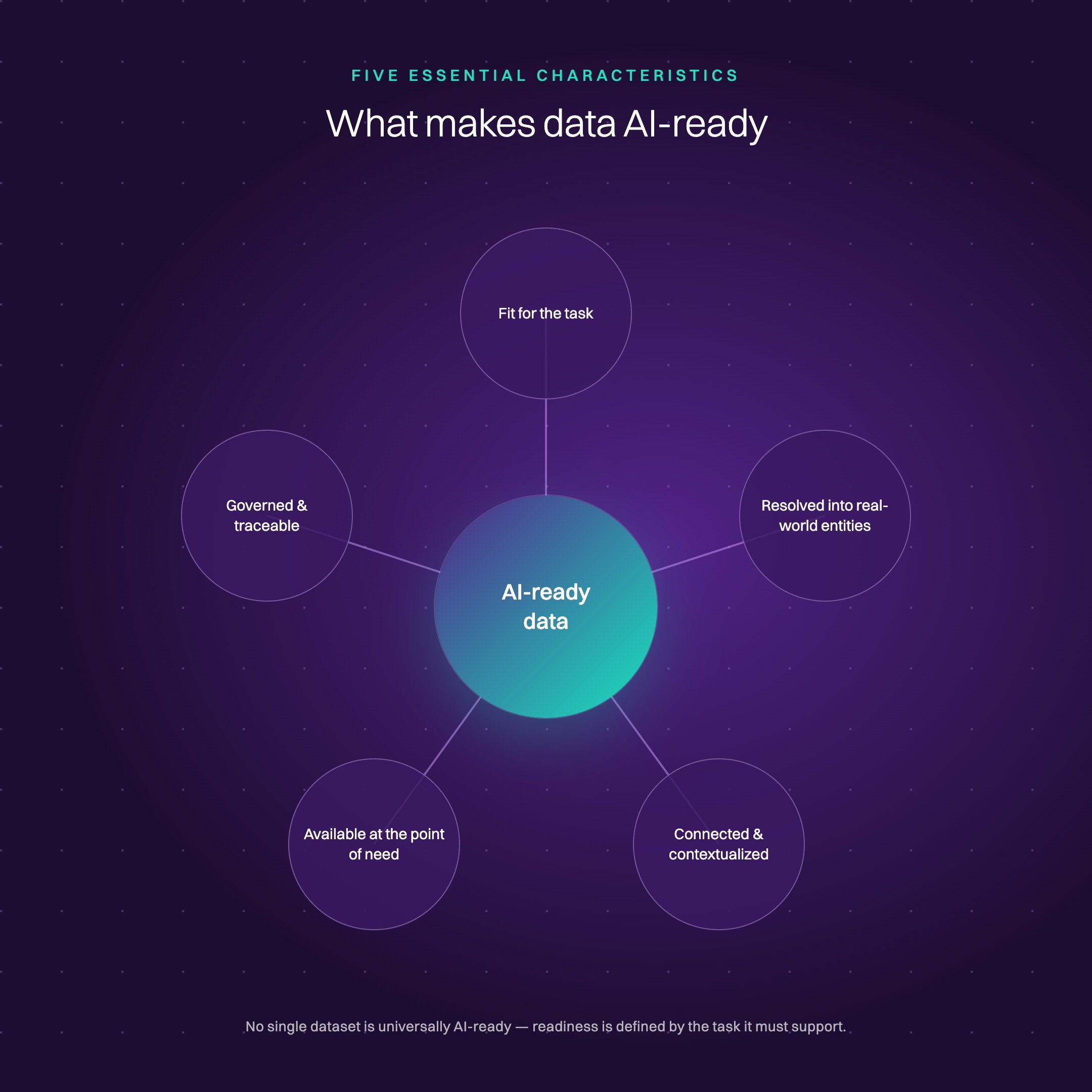
There’s no universal threshold for AI readiness. The precise requirements will vary by use case, but a model or agent needs enough reliable information to interpret the situation and support the outcome in scope. Five characteristics provide a practical framework for assessing enterprise data to maximize AI efficacy.
Fit for the task
Data is truly fit for the task when it represents the full situations for the AI model to compute. That includes accommodating for less common cases, and meeting quality thresholds the decision or action requires. For example, a missing field may have little effect on a policy search but can materially change a credit or risk decision.
Resolved into real-world entities
AI needs a reliable view of who or what each record represents. Entity resolution brings records referring to the same person or organization into one coherent view while keeping separate entities apart. Without it, AI may see only part of a customer’s history or attribute activity to someone else.
Connected and contextualized information
A resolved identity establishes who or what is involved; context shows how that entity relates to the wider situation. Representing these relationships gives AI a more thorough basis for interpreting the information in front of it.
Available at the point of need
AI-ready data needs to reach the system in time to inform the decision. The required level of freshness varies by use case, so each system should have dependable access to information that is current enough for the task.
Governed and traceable
AI-ready data should retain its source and any restrictions on use as it moves into an AI workflow. This allows reviewers to trace an outcome back to the available evidence and assess whether it was suitable for the decision.
How to build an AI-ready data foundation
Many organizations already hold much of the data their AI initiatives need. The challenge lies in turning fragmented information into a dependable foundation that can support production use. The steps below provide a practical route through this work.
Define the outcome: Establish who will rely on the AI output and what they will do next. This sets expectations for reliability and oversight.
Assess the current data: Compare what the use case needs with what the existing data environment can provide. Focus first on the gaps that could affect the outcome.
Connect and prepare the sources: Bring together the relevant internal and external data, ensuring updates can reach the system at the required pace. Correct genuine errors and standardize meaning without removing useful differences.
Resolve the entities: Establish which records refer to the same real-world person or organization. Test for underlinking and overlinking so that connections aren’t missed or attributed to the wrong entity.
Add business context: Connect resolved entities to the relationships and activity surrounding them. A contextual data model or knowledge graph can represent the wider situation behind the decision.
Build in governance: Preserve provenance and restrictions as data enters the AI workflow. Access controls should protect sensitive information, with clear ownership for data quality and automated outcomes. Higher-risk workflows may also require human review and a way to pause or reverse automated action.
Test and extend the foundation: Validate the foundation against the intended outcome and monitor its reliability as the data changes. Once the approach is working, package the trusted view as a maintained data product that other teams can reuse.
The resulting foundation should provide a clear path from source data to decision. This visibility will help teams understand where confidence in an outcome comes from and where further scrutiny is needed.
Common challenges that prevent enterprises from achieving AI-ready data
Preparing an existing data environment for AI often brings previously hidden gaps to the surface. Recognizing the main barriers early makes it easier to understand the work required and plan around it.
Fragmented data and organizational silos: Relevant information often sits across systems owned by different teams, leaving AI with partial or conflicting views of the same real-world entity.
Poor quality and inconsistent definitions: Quality problems and incompatible formats make data difficult to combine. Differences in business meaning can also cause seemingly similar fields to be interpreted incorrectly.
Missing identity and relationship context: Exact matching may fail to recognize records that refer to the same entity. Important relationships can also remain hidden, preventing AI from seeing how a person or organization fits into the wider situation.
Legacy architecture and slow data access: Architecture designed for scheduled reporting may not provide current data when operational AI needs it. Supporting faster workloads can require changes to existing pipelines or source systems.
Unclear governance and access controls: When ownership is unclear, quality problems can persist and accountability becomes harder to establish. Inconsistent controls may expose sensitive information or prevent an AI system from retrieving context it is permitted to use.
What does AI-ready data look like in practice?
The examples below show how AI-ready data changes the evidence available to a system at the point of decision.
Enterprise AI copilot
A document-based RAG system may retrieve a stated owner without revealing how ownership passes through intermediate companies. By applying real-world context, agents and users can assess the business and trace connections to the ultimate beneficial owner, making the reasoning behind the answer visible.
Real-time fraud or financial crime detection
AI can assess a transaction in the context of the customer’s resolved identity and activity across the wider network. This may reveal patterns or counterparties that materially change the level of risk.
Q Labs finding
In Quantexa Q Labs experiments, agents using contextualized data delivered around 40% better risk mitigation than those working without this context.5 In one scenario, hidden network connections led an agent to re-rate a suspicious insurance claim from medium to high risk.
Customer intelligence
Records held by different departments can be resolved into a trusted customer view that supports more than one application. The same foundation can inform how the organization serves the customer and manages related risk.
Customer example: Novobanco
Novobanco is working with Quantexa and Microsoft to remove data silos and create a unified foundation for analytics and AI.5 The bank now operates more than 50 AI models across its data estate, supporting use cases that include fraud detection and personalized customer experiences.
Achieving AI-ready data with Quantexa
At Quantexa, we see AI readiness as the ongoing ability to deliver trusted enterprise context wherever AI informs a decision or action. The Contextual Fabric within our Decision Intelligence Platform turns fragmented information into a resolved and connected foundation for analytics and AI-driven decisioning.
Resolve entities and reveal their context: Bring together data from across and beyond the enterprise, then use entity resolution to establish accurate views of the people and businesses involved. Knowledge graphs connect those entities to the relationships and activity surrounding them.
Create reusable AI-ready data products: Package resolved and contextualized information so further teams can build on the same trusted view. These capabilities integrate with existing data platforms, allowing the foundation to expand without requiring a complete architectural replacement.
Ground generative AI in enterprise knowledge: Q Assist grounds generative AI in resolved data and graph-based context when an end-user submits a text-based query in the Quantexa Platform. This can improve the relevance of its answers and reduce the risk of unsupported responses.
Give AI agents governed access: Agent Gateway connects agents to approved enterprise context and analytics through Model Context Protocol (MCP), giving them a consistent view of the current situation. Governance is applied at the point of access, with an auditable record of the resulting actions.
Support explainable decisions: Preserve the source evidence and context behind each output. Reviewers can then reconstruct how an individual outcome was reached and defend it if challenged.
Explore our Decision Intelligence Platform to see how trusted, contextual data can support AI across your organization. Or request an AI-ready data assessment to identify gaps in your current foundation and define a practical starting point.
FAQs about AI-ready data
What does it mean for data to be AI-ready?
AI-ready data is data prepared for a defined AI use case and made dependable enough for the outcome in scope. It gives the system an accurate view of the real-world subjects involved, together with the context needed to interpret them. The data must also reach the system at the right time. Clear provenance and usage controls make it possible to govern how it informs decisions.
Is AI-ready data only needed for generative AI?
No. Generative AI needs trusted enterprise knowledge to retrieve relevant evidence and produce grounded answers. The same principle applies to predictive models and automated decision systems.
A fraud model, for example, needs to know which customer is behind a transaction and how the activity compares with their previous behavior. Connections to other parties may also change how that transaction should be interpreted.
How do you govern AI-ready data?
Governance begins with assigning ownership for the data and defining the quality standard it must meet. As the data moves into an AI workflow, lineage records its source and path through the system, and access controls enforce its permitted use. Monitoring can then identify failures or changing conditions once the system is live. Higher-risk applications may also require human review and a clear process for challenging automated outcomes.
Does all enterprise data need to be AI-ready?
No. Data only needs to be prepared to the standard required by the AI use cases it will support. Attempting to address the entire data estate at once can add considerable cost without creating equivalent value.
A more practical approach is to begin with the information required for a clearly defined, high-value use case. The foundation can then expand as further teams or AI systems need trusted data.
Why do most AI projects fail before reaching production?
Many AI projects stall because a successful prototype does not prove that the underlying data can support production use. Relevant information may remain fragmented across systems or arrive too late for the workflow. Unclear ownership and usage restrictions can also block deployment. An AI-ready foundation addresses these issues before the system is scaled.
Is a vector database sufficient to support an AI-ready data foundation?
No. Vector databases play an important role in many AI architectures, particularly for semantic search and retrieval-augmented generation (RAG), but they are only one component of an AI-ready data foundation.
While vectors help AI systems find relevant information, they do not fully resolve the underlying challenges of enterprise data such as fragmented records, duplicate entities, inconsistent identifiers, missing relationships, or unclear governance. As a result, an AI system may retrieve relevant content but still lack an accurate understanding of the people, organizations, products, events, and connections involved.
Is a semantic or context layer an essential element of an AI-ready data foundation?
Not always, but for many enterprise AI use cases, a semantic and/or context layer is a key component of an AI-ready data foundation.
AI models and agents do not simply need access to data. They need an accurate understanding of what that data represents, how it relates to other information, and how it should be interpreted in a business context. A context layer, including a semantic layer, provides this understanding by connecting data to business concepts and governance rules.
However, while the context layer provides the machinery to map data to AI based on business meaning, to be impactful to the business, AI systems should be architected to reconcile conflicting records, understand relationships across records, and ensure consistency and reproducibility across decisions and actions. This maximizes accuracy, explainability, and trust.
Useful links
We’ve discussed AI-Ready Data in detail in this guide. However, there could be more you want to know about the impact it can have on your organization. Browse the following articles for further reading.