


Key takeaways
 A data foundation brings together the technology and processes needed to make data more trustworthy and accessible across the organization.
- Without a data foundation, enterprises risk making decisions based on incomplete or conflicting information. AI models and agents can repeat those errors at scale.
- Building a trusted foundation involves connecting relevant data, improving its quality, and making records consistent. Governance defines who is responsible for that data and how it may be used.
- A data foundation can be built in stages around specific business needs. Each new use case can reuse the foundation while applying its own view.
A data foundation is the set of capabilities that connect enterprise data and prepare it for use, spanning ingestion, quality, resolution, governance and delivery. It is an enterprise capability rather than any single platform. This guide is for data and IT teams. At Quantexa, we help organizations turn fragmented information into a connected, reusable foundation their decisions and AI can rely on.
What is a data foundation?
A data foundation is the set of technical and data management capabilities used to connect enterprise data and prepare it for use. It provides a reliable basis for the systems, people, and AI models that depend on that information.
A data foundation is built by bringing relevant data together from internal and external sources. Quality controls are applied to keep the information accurate over time, and governance determines who can access it and for what purpose. The resulting data can be reused across different parts of the organization.
Enterprise data may contain several records for a single person or organization. Entity resolution links those records to create a more accurate real-world view, even when the source data is inconsistent. Knowledge graphs add further context by showing the relationships between resolved entities.
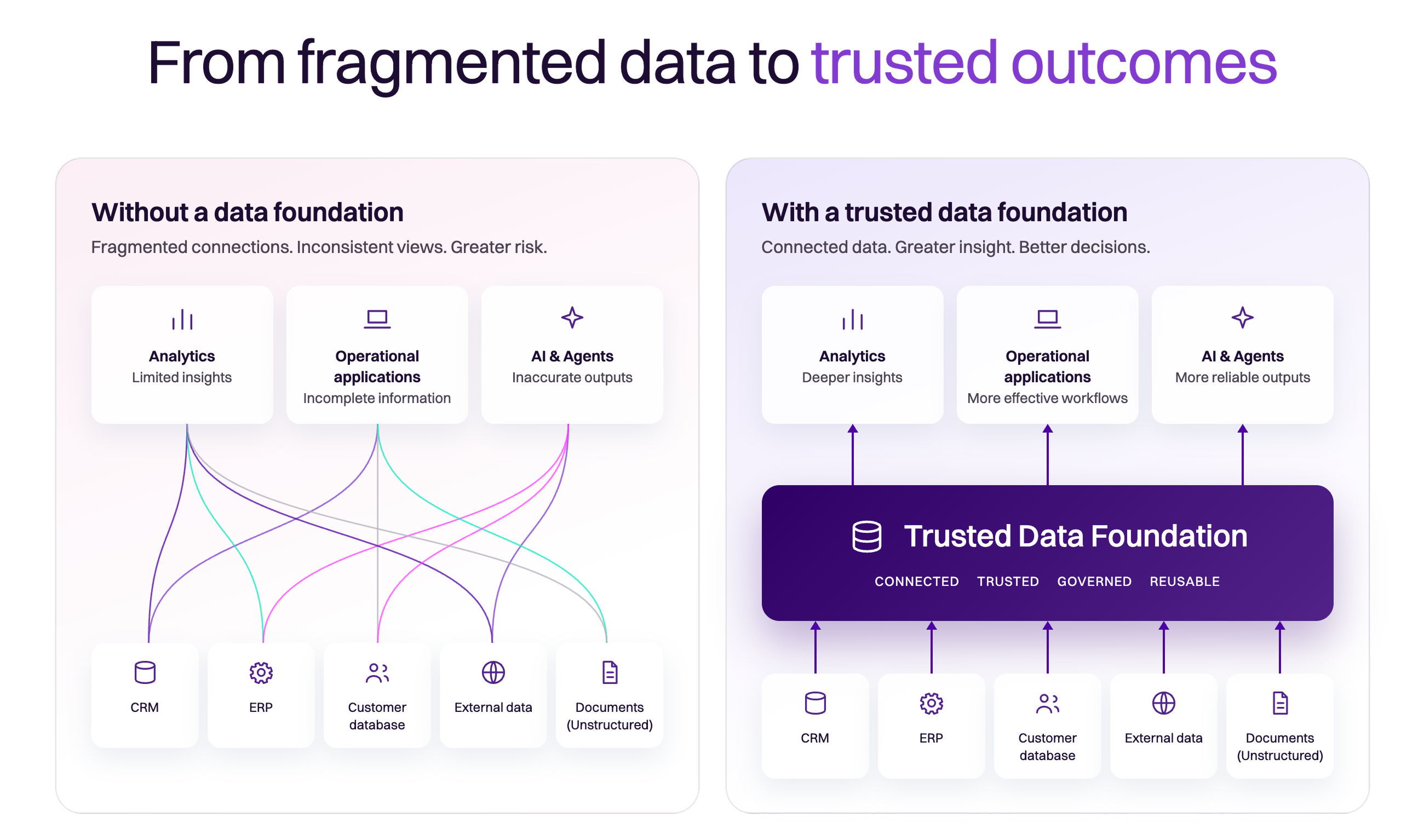
What is the difference between a data foundation and a data platform?
A data platform usually refers to a specific technical environment used to store and process data. A data foundation is an enterprise capability that can span several platforms and source systems. A data platform can therefore provide part of the technical base for a foundation without representing the whole of it.
Terminology varies across the industry and among ecosystem participants. Comparing the capabilities included gives a clearer picture than relying on the label alone.
Why do enterprises need a trusted data foundation?
Enterprises need a trusted data foundation because decisions and AI are only as reliable as the information behind them. In practice, AI can only work with the information it receives, so incomplete or inconsistent data can produce inaccurate outputs. Decisions made by people are also affected when the relevant information is spread across separate systems.
Understanding one customer’s history, for example, can require a service advisor to check several systems. An AI assistant connected to only one of those systems could recommend the wrong next step because it cannot see the customer’s full history. A risk analyst faces a similar task when duplicate company records must be reconciled before calculating exposure. Teams often end up repeating the same preparation for each new workflow or analysis.
Without a trusted data foundation, decisions take longer and are more likely to be based on conflicting information. Outcomes are also harder to explain when the supporting data has been assembled manually or changed between systems.
These risks become especially clear when decisions are time sensitive. The Bank for International Settlements reports that during the global financial crisis, some major banks took days or longer to calculate their exposure to a single counterparty, even though this information was needed several times a day. A 2026 Basel Committee update also identifies the ability to produce timely ad hoc risk reports as a significant hurdle for some banks.
A trusted data foundation gives each workflow access to reliable information in a form suited to the task:
Area | Without a trusted data foundation | With a trusted data foundation |
Customer service | An advisor searches several systems and may miss part of the customer’s history | The CRM provides a current customer view using information the advisor is permitted to access |
Financial crime | An investigator spends time gathering records and may assess an alert in isolation | Relevant identities and supporting evidence are available alongside the alert |
Risk management | Duplicate company records can distort calculations of total exposure | Risk is calculated using a consistent view of the organizations involved |
Data management | Teams repeatedly correct the same problems in downstream datasets | Recurring quality issues can be traced back to their source |
AI | A model produces outputs from incomplete information that may be difficult to verify | The model receives governed data, with evidence available to support its output |
What are the key components of a data foundation?
A data foundation brings together the capabilities needed to move information reliably from source systems into trusted use. At Quantexa, we see these as including:
Data architecture and infrastructure: Storage and processing infrastructure forms the technical base of the data foundation. It may span existing cloud platforms, warehouses, lakes, and on-premises systems.
Data ingestion and integration: Ingestion brings relevant data into the foundation from internal systems or external sources. Integration then prepares the information so it can be connected and used across the wider data estate.
Data quality and observability: Quality processes identify information that is incomplete, inconsistent, or unsuitable for its intended purpose. Continuous monitoring allows teams to address new issues as the data changes.
Data unification and mastering: Different systems may hold duplicate or conflicting information about the same real-world entities, such as customers or suppliers. Data unification brings these records together to create trusted views for use across the organization.
Metadata management: Metadata provides information about what data means, where it came from, and who owns it. Managing this information effectively helps organizations find and understand their data while supporting consistent governance.
Governance and security: Governance establishes ownership and defines how the data should be maintained. Security controls determine who can access it and which uses are permitted.
Data products and access: Trusted data needs to reach the people and systems that use it. Reusable data products can deliver it into operational applications, analytics, and AI in a form suited to each task.
Connected data and context: A data foundation should help organizations understand individual records and the relationships between them. Connecting this information provides the context needed to support decision-making and use across operational processes, analytics, and AI.
How to build a trusted data foundation for AI, analytics, and operational decisions
To build a trusted data foundation, enterprises need to improve how data is used without disrupting the systems that already support the business. A staged approach makes this more manageable, beginning with a specific use case and extending the foundation from there.

Define the required outcome
Choose the use case the foundation will support. Establish what needs to improve and how current or complete the data must be.

Map and connect the relevant data
Identify the sources needed and how information currently moves between systems. Connect these sources without replacing the wider data environment unnecessarily.

Establish data quality
Assess whether the information is complete and consistent enough for its intended use. Continue monitoring it so recurring problems can be corrected at their source.

Create a single view and understand relationships
Bring fragmented records together and resolve duplicates to create a single view of the entities they represent. Identify relevant relationships within the data to provide a better understanding of the wider situation.

Build in governance
Assign accountability for maintaining the data and define who can access it. Keep its source and use traceable as it moves between systems.

Deliver data in the right form
Provide data at the speed and in the format each workflow requires. An operational application might need live API access, while analysis can often use scheduled batch data. Matching and access rules can also differ by use case.

Measure and expand
Track whether the foundation is improving the outcome defined at the start. Measures can include the time spent preparing data and the frequency of recurring quality issues. The capabilities developed can then be refined and reused for the next priority.
Common challenges of building a data foundation
Data foundation initiatives can encounter a range of challenges as they move from planning into day-to-day use. These may include:
Starting with too broad a scope: Trying to design for the entire enterprise before delivering one use case can extend timelines and make progress difficult to measure. A defined initial scope provides a practical basis for expansion.
Treating it as a technology project: New platforms can improve how data is stored and accessed, but they cannot determine what the information means or who is accountable for it. Existing errors will continue downstream unless these issues are addressed.
Failing to maintain quality and accountability: Data quality changes as new information enters the foundation. Named owners need the authority to correct recurring issues and review whether access is still appropriate.
Keeping trusted data inside the platform: A data foundation creates value when its outputs reach the decision or service they are intended to support. Otherwise, teams will continue assembling information manually within downstream systems.
Overlooking trust and adoption: A data foundation will have limited impact if users do not trust or consistently use the information it provides. Teams need to understand where the data comes from and have confidence that it is suitable for their needs.
How Quantexa helps build a trusted data foundation
At Quantexa, we help organizations turn fragmented enterprise information into a connected and reusable foundation. Our platform works with existing data environments, creating a route from source data to governed outputs that can support different needs across the enterprise.
Connect existing data sources: Bring together structured and unstructured data from internal systems and trusted external sources. Schema-agnostic ingestion helps organizations onboard relevant information without replacing their wider data estate.
Prepare data for use: Clean and standardize records so information from different systems can be compared reliably. AI-powered models can also extract useful information from unstructured sources before resolution and analysis.
Resolve real-world entities: Use Entity Resolution to establish which records refer to the same person or organization, even when the underlying details are inconsistent. Dynamic Entity Resolution allows the resulting view to reflect the requirements of each use case.
Improve data quality in context: Assess data quality after records have been resolved, when incomplete or incorrectly linked entities become easier to identify. Data stewards can then route issues into remediation workflows and address recurring problems within source systems.
Create trusted master data: Build trusted views of customers, organizations, and other critical business entities. By combining resolved data with relationship and contextual insights, organizations can establish a modern approach to master data management that supports operational processes, analytics, and AI initiatives.
Reveal relationships and wider context: Use knowledge graphs to show how resolved entities connect to the activity surrounding them. The Contextual Fabric within our platform makes this connected view available for analysis and decision-making.
Put trusted data to work: Help teams package resolved and contextualized outputs as governed data products. These can be delivered into business applications or used to support analytics and AI without recreating the underlying foundation.

Frequently asked questions about data foundations
Does a data foundation require all enterprise data to be stored in one place?
No. A data foundation can connect data across existing systems without moving all of it into one location. Information can stay in the source systems or storage environments where it already resides. The foundation provides a consistent way to access and govern that information before bringing together the data required for each decision or service. This allows organizations to build around their existing technology and avoid a wholesale migration.
Isn’t a data foundation just a database or a data lake?
No. A database or data lake provides infrastructure for storing and managing data. A data foundation is broader, bringing this infrastructure together with the governance and processes needed to make data trusted and usable.
This means data is not simply stored but managed so it can be accessed securely and used reliably across the organization. Databases and data lakes can form part of a data foundation, but they do not provide the complete foundation on their own.
Does every use case need the same view of the data?
No. A shared data foundation makes trusted data reusable while allowing each use case to apply its own access and matching rules. Customer service may need a focused view of the customer’s account history, for example. A financial crime investigation could require additional sources and wider relationship context. Both can draw on the same underlying data connections without receiving an identical view.
How does a data foundation support AI models and agents?
A data foundation gives AI models and agents access to reliable, governed information about a task or decision. Entity resolution helps establish who or what is involved, while contextual data shows relevant relationships and activity, based on the ontology relevant to the use case and organization. Access controls determine which information the AI can retrieve. Traceable source evidence also allows people to review its outputs and actions, which is especially important when an AI agent can act without prior approval.
Who is responsible for managing a data foundation?
Responsibility for a data foundation is usually shared across business and technical roles, but accountability should be assigned clearly. This will often sit with the Chief Data Officer (CDO) or another senior data leader, who sets the organization’s approach to data governance and management.
Data owners and stewards manage responsibilities within individual business domains, including how information is defined and addressing day-to-day quality issues. Technical teams operate the supporting infrastructure and security controls.
AI makes clear accountability even more important, as organizations need to know who is responsible for the data being used by AI systems. Documenting these responsibilities helps ensure issues can be directed to the person or function with the authority to resolve them.
How can an organization measure whether its data foundation is working?
Organizations should begin with the business outcome the foundation was built to improve. This could be the time required to understand a customer or calculate financial exposure. Data measures can then track preparation time and the frequency of recurring quality issues. Organizations can also assess how quickly trusted data can be reused for a new workflow. Establishing a baseline before work begins will make any change easier to measure.
Useful links
We’ve discussed data foundations in detail in this guide. However, there could be more you want to know about the impact a trusted data foundation can have on your organization. Browse the following articles for further reading.