


Key takeaways
 Data products provide a structured way to manage enterprise data for continued use. Instead of treating each data requirement as a separate project, organizations can develop data around recurring consumer needs.
- A data product requires active ownership and management. Defined standards for documentation, governance, and maintenance help keep it reliable for consumers.
- Data products become richer as more context is added. They can progress from cleaned and standardized data to connected information that provides more context for specific business needs.
- Data products provide a more reliable foundation for enterprise AI. They give AI models and agents governed information that can be used consistently across different tasks.
Data products package data with the ownership, governance, and documentation needed for repeated use, instead of rebuilding it for each new project. This guide is for data and IT teams. At Quantexa, we group data products into three types: foundational, contextual, and analytical.
The value of enterprise data depends on how easily it can be put to use. A dataset created for one project may answer an immediate need, but its value is limited if the same work has to be repeated for the next use case. This is where data products come in, helping organizations get more value from the data they already have.
This guide explores what data products are, why they are important, and how to build them around business needs.
What is a data product?
A data product is data that is packaged and managed like a product for ongoing use. It is designed around the needs of its intended consumers, with clear ownership and requirements for how it should be used and maintained.
A data product also includes the documentation, metadata, and controls consumers need to use the data effectively. These consumers could include business teams or downstream systems. Increasingly, they also include AI models and agents.
In practice, data products can support a wide range of business needs. A customer data product might provide a consistent view of customers across different business processes, for example. A transaction data product could provide information prepared for recurring risk analysis.
Data products can take different forms depending on how they will be consumed. They might be made available as datasets or through APIs, while a dashboard could provide an interface for accessing them.
What isn’t a data product?
A dataset, dashboard, or API does not become a data product simply because consumers can access it. It needs to be managed for an ongoing need, with defined ownership and Service Level Agreements (SLAs) for its maintenance and use.
What are some examples of data products?
Data products can support a wide range of business needs. Common examples include:
Business Customer: A trusted, unified view of each business customer, enriched with corporate hierarchies and relevant information. This can support decisions across customer intelligence, credit risk, KYC, fraud, and compliance.
Individual Customer & Household: A connected view of individual customers, their households, product holdings, and credit information. This can support personalized service, cross-sell, risk assessment, and regulatory processes.
Supplier: A consolidated view of suppliers, their organizational relationships, and relevant business information. This enables teams to understand dependencies and assess risk, as well as to strengthen supply-chain decision-making.
What are the characteristics of a data product?
What makes data a product is how it is prepared and managed for its intended consumers. This includes several core characteristics:
Consumption-ready: The data product should be prepared for its intended consumers without requiring significant additional work before they can use it. This includes meeting defined standards for quality and availability.
Reusable: A data product should support a recurring need and, where appropriate, be reusable across more than one use case.
Documented and discoverable: Consumers need to understand what the data product contains and how it should be used. Clear metadata and documentation provide this information, and marketplaces can make data products easier to find.
Governed and trusted: Data quality should be monitored based on consistent rules. Controls should be in place to determine how the data product can be accessed and used. Its sources and transformations should also be traceable so consumers can understand where the information came from.
Owned and maintained: A named owner should be accountable for maintaining the data product and ensuring it continues to meet consumer needs.
Interoperable: A data product should be available in a form that allows it to work with the systems that need to consume it, whether it’s downstream applications, AI agents, or human decision makers.
Data product vs. data asset: what’s the difference?
A data asset is a valuable data resource, such as a dataset that can be used to support business processes, analytics, or AI initiatives.
A data product is a data asset packaged with ownership, governance, quality standards, documentation, access mechanisms, and service expectations so it can be reliably consumed and reused across the organization.
Data asset | Data product | |
Quality | Quality may depend on the source or project that created it | Quality standards are defined and monitored for its intended use |
Metadata | May have documentation, not mandatory | Includes metadata and documentation with business definitions, source and lineage information |
Governance | Controls may be applied at the system or data asset level | Governance requirements are defined around how the data product can be maintained, accessed, and used |
Ownership | Responsibility may sit with the team or system that holds the data | A named owner is accountable for the data product |
Maintenance | May be infrequently updated without a defined service commitment | Maintained throughout its lifecycle against agreed requirements |
Consumption | Consumers may need to prepare or interpret the data before use | Designed to be consumption-ready for its intended users or systems |
Reuse | May have been created for one project or purpose | Designed for repeatable use and can support multiple use cases |
What are the different types of data products?
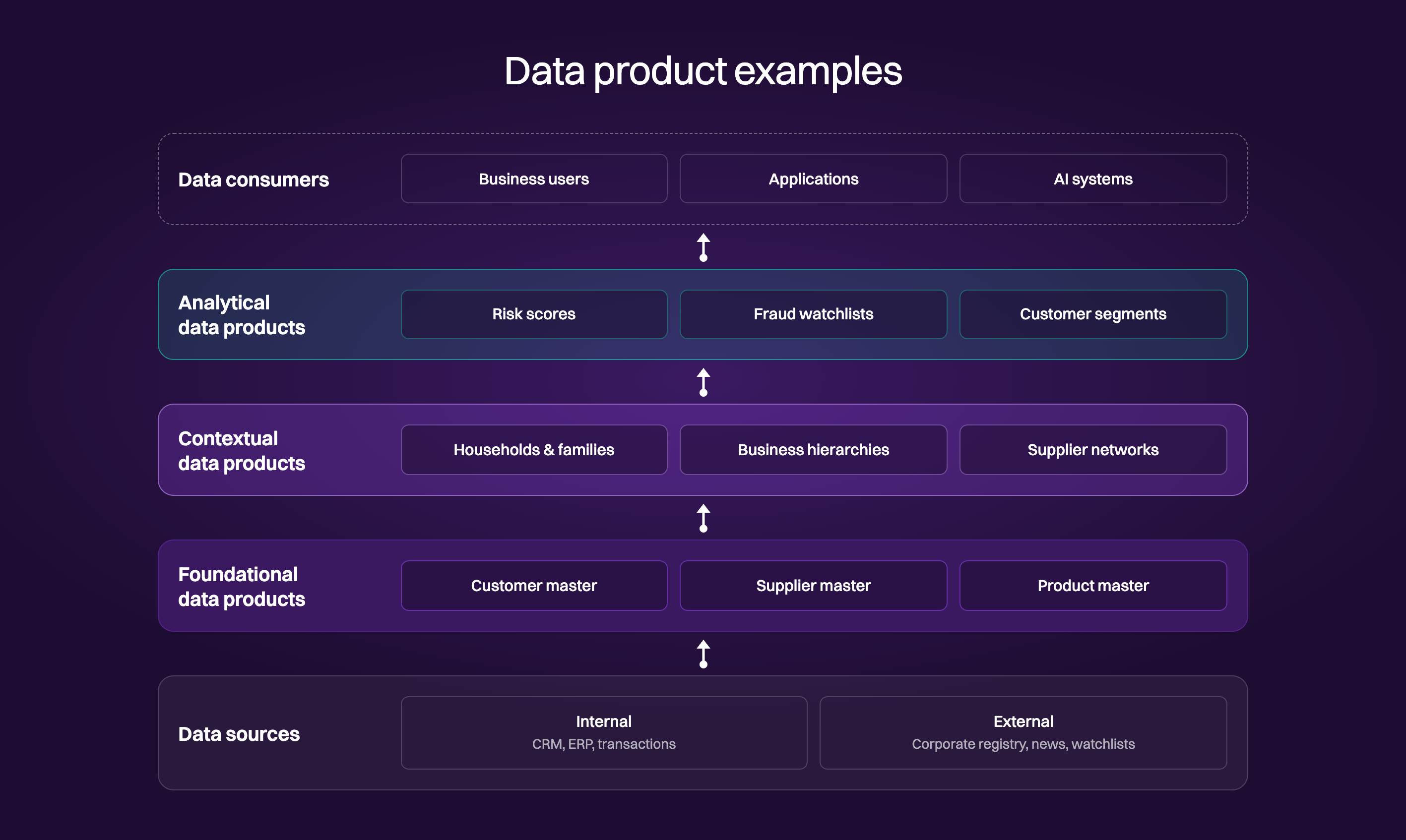
Data products can build on each other as data becomes more connected and ready for specific uses. At Quantexa, we group them into three types:
Foundational → Contextual → Analytical
Foundational data products
Foundational data products contain cleaned and standardized information from individual sources. Examples include customer master, supplier master, or product master.
Contextual data products
Contextual data products build on foundational data products to add relationships, connections, and context around entities, typically represented as a knowledge graph, to provide richer information for the end user. Examples include households and families, business hierarchies, and transaction relationships.
Analytical data products
Analytical data products generate insights, scores, predictions, or recommendations from foundation and context. Examples include products used for fraud watchlists, credit risk assessment, or supply chain analysis.
Why are data products important?
Data products shift the focus of enterprise data management from delivering data for individual projects to creating capabilities that can continue to provide value over time. Gartner links the rise of data products to growing demand for self-service and domain-driven data management.1 Its 2026 research also examines how data product practices need to evolve to support AI agents alongside human consumers.2
This approach can change how organizations invest in and manage data:
Data products can extend the value of data work: Rather than measuring success only by the delivery of a dataset or pipeline, organizations can look at how often a data product is adopted and reused. This allows the work involved in preparing the data to support new consumers and use cases.
Data work is connected to business outcomes: Data products are developed around a defined business need rather than data delivery alone. This makes it easier to measure their value against the decisions, processes, or outcomes they are designed to support.
New use cases can build on existing data capabilities: Teams do not need to build every requirement from scratch as analytics, applications, and AI evolve. Existing data products can provide building blocks that are adapted or combined for new needs.
Why do AI and AI agents need data products?
Data products help AI models and agents access trusted, governed, and reusable data. Without them, AI systems rely on data that is often incomplete, difficult to access, or lacks the context needed to generate accurate outputs and decisions. This creates a challenge for enterprises where relevant information is spread across different systems and managed in different ways.
Data products define what data is available and how it should be interpreted. They also establish the policies that govern access. AI systems can consume data products through APIs, Model Context Protocol (MCP) servers, retrieval-augmented generation (RAG) pipelines, or other integration mechanisms, depending on the needs of the application.
Contextual data products go beyond describing individual entities to capture the relationships between them, creating the real-world context needed to understand how those entities are connected. This enables AI models and agents to reason over how customers, organizations, accounts, products, and events are connected, leading to more accurate decisions and recommendations.
For example, when assessing a suspicious transaction, an AI agent may identify that seemingly separate records belong to the same individual and uncover previously hidden links to organizations or activities associated with elevated risk.
How do you build a data product?
Although the exact approach will vary, organizations can use the following steps as a practical framework for building a data product.
Define the business need: Identify the business use cases the data product should support. Establish the intended outcome so development stays focused and the data product’s value can be measured later.
Define the product requirements: Specify how the data product will be used, who it is intended for, and the standards it must meet. Set expectations for quality, timeliness, security, accessibility, and governance. Document the data, including its purpose and lineage. Where appropriate, data contracts can formalize the commitments between producers and consumers on structure, availability, and quality.
Assign ownership: Establish clear accountability for the data product throughout its lifecycle. An identified owner should define the product vision and prioritize improvements, ensuring it meets consumer needs and continues to evolve. They should also oversee its quality and adoption.
Identify and prepare the data: Work backwards from the use case to identify the required data sources. Prepare the information for its intended use, which could involve cleaning and standardizing it, resolving records that refer to the same entity, and adding relevant relationship context.
Build an MVP: Develop a minimum viable product (MVP) around the initial use case rather than trying to anticipate every future requirement. Test it with its intended consumers and use what you learn to refine the product before extending it to further needs.
Publish and drive adoption: Make the data product easy to discover, understand, and consume. Provide clear documentation describing its purpose, contents, quality, ownership, and intended use cases, and publish it through a data catalog or marketplace. The product should be accessible through delivery mechanisms that match consumer needs, such as batch datasets, SQL access, APIs, event streams, or MCP-enabled interfaces for AI agents. This ensures users and AI systems can consistently access trusted data through governed channels.
Monitor and evolve: Manage the data product as a living product. Track adoption and consumption patterns to understand how it is being used. Monitor its quality, performance, and reliability to understand whether it meets consumer needs and delivers business value. Use feedback from users, applications, and AI systems to guide improvements as requirements change. Regularly review whether the product supports its intended business outcomes and decisions to prioritize future investment.
How Quantexa supports contextual data products
As organizations move beyond foundational data products, the challenge (and the expected value) shifts from understanding individual entities to understanding the context around them. Contextual data products combine trusted entity data with the relationships and networks that uncover how people, organizations, accounts, assets, and events are connected.
Create trusted business entities
Use our Entity Resolution capabilities to establish accurate views of customers, organizations, suppliers, and other core entities across fragmented data sources. This creates a consistent foundation using information from internal and external sources.
Build real-world context
Automatically identify and maintain the relationships between entities, creating connected views that reveal ownership structures, customer networks, supplier ecosystems, behavioral patterns, and other business-relevant connections. This real-world context becomes a reusable asset rather than remaining buried across multiple systems.
Create reusable contextual data products
Use real-world context to build data products that support business needs, from customer intelligence and risk management to fraud detection and compliance. These products provide a shared source of business context that can be consumed across applications, AI, analytics, and operational processes.
Make context available to AI and agents
Deliver contextual data products securely to AI applications and agents through APIs, contextual RAG, and our Agent Gateway. This gives AI systems access to the real-world context needed to support more accurate recommendations, decisions, and actions.
Establish a foundation for agentic AI
Provide AI agents with a governed source of entity data, relationships, and business knowledge that can be reused across multiple tasks. This helps agents operate with trusted, explainable context rather than fragmented or incomplete data.
Sources
Gartner, How to Build and Manage Data Products, Nina Showell, Robert Thanaraj, Michele Launi, Roxane Edjlali, Thornton Craig, 13 November 2025.
Gartner, Playbook to Launch and Scale Agentic AI-Ready Data Products, Soyeb Barot, Dalia Naguib, Sarah Turkaly, Richa Jha, 21 July 2026.
Frequently asked questions about data products
Who owns a data product?
A data product should have a named owner who is accountable for the need it serves and the value it provides to consumers. Depending on the organization, a data product manager may oversee its development, adoption, and ongoing management.
How do you measure the success of a data product?
Success should reflect both how the data product is used and the outcome it supports. Measures could include adoption and reuse, data quality, service levels, and whether the data product is contributing to its intended business outcome.
Do data products need to be always updated in real-time?
No. The update frequency of a data product should reflect the needs of its consumers and use cases. Some products, such as fraud detection, operational decisioning, or AI-powered applications, may require real-time or near-real-time updates. Others may be refreshed hourly, daily, weekly, or on another defined schedule. The goal is delivering data with the timeliness required to support the decisions, processes, and AI systems that depend on it.
Do you need data mesh to build data products?
No. While data products are a foundational principle of data mesh, they can be implemented within a wide range of data architectures and operating models. Organizations can develop and manage data products using centralized, federated, or domain-oriented approaches. The core concept is treating data as a managed product with clear ownership, quality standards, governance, and consumption patterns, regardless of the underlying organizational structure.
Useful links
We’ve discussed data products in detail in this guide. However, there could be more you want to know about the impact they can have on your organization. Browse the following articles for further reading.