Trusted AI in Banking Starts With Master Data. Here's How to Build It.
Fragmented data is banking’s biggest obstacle to delivering trusted AI outcomes. A pragmatic master data approach is the foundation that changes everything.

Trusted AI in Banking Starts With Master Data. Here's How to Build It.
Fragmented data is banking’s biggest obstacle to delivering trusted AI outcomes. A pragmatic master data approach is the foundation that changes everything.




Today, AI is firmly planted on most banks’ agendas, but many AI initiatives stall. Not because of a model problem, but because of a data problem. A MIT Technology Review study of the banking sector found that 70% of banking executives use agentic AI in some capacity (“Reimagining the future of banking with agentic AI”, 2025). Whether financial leaders are seeking earlier, more accurate warning signals, sharper insights, or simply better task automation, the lofty promises of AI are no less ubiquitous in the banking sector than in any other industry.
And yet, the financial sector faces particular consequences of AI-related failures that extend beyond wasted budget into unreliable AI outputs, compliance risk, and reputational damage. It’s little wonder that many banking leaders remain hesitant about implementation, caught between competitive pressure to adopt and a well-founded fear of getting it wrong.
It’s important to understand that failures occur not because of problems endemic to AI, or even models, but because the data underlying them is fragmented, duplicated, and disconnected. This is where master data management (MDM) is re-emerging: not only in a governance capacity, but as a component of an AI-driven system that creates real value.
Why AI in banking fails without master data management
In most banks, core entities such as customers, accounts, and counterparties exist in fragments across CRM, core banking, payments, lending, and risk platforms. AI cannot resolve this problem; in fact, it only amplifies the issues caused by siloed data. For instance, an AI agent doesn’t know that “John Smith at 42 High Street” and “J Smith at 42 High St” are the same person, or that multiple subsidiaries share a common owner. Even sophisticated AI models fail when they’re built on fragmented data without context.
This is the reasoning behind Gartner’s assertion that organizations must take a pragmatic approach to MDM (Doing “Just Enough” Master Data Management for Analytics and AI, 2025), with modern data strategies leveraging a ‘minimum viable product’ approach to consistent master data management for AI and analytics. Banks today don’t need perfect golden records before they can begin gaining meaningful impact from AI. Rather, they need a few key capabilities:
Ability to determine consistent identities across systems and act on that knowledge instantly, across every touchpoint
A shared way to join data across departments or organizations using a unified entity layer, rather than maintaining different versions of a customer record
The flexibility to move at the speed of the business, with the right architecture that delivers value incrementally
In short, master data becomes a digital core that can be harnessed to support AI, analytics, and operations, turning fragmented records into trusted, connected entities and delivering them to both humans and machines at the decision point.
A 5-step framework to deliver master data for AI
For years, traditional MDM programs operated on the premise that only a “complete” program could deliver value – and most never got there. Instead, multi-year initiatives consumed budget and goodwill before a single business outcome was realized. That approach is incompatible with banking, where priorities shift constantly and time-to-value matters.
A more effective approach focuses on fitness for purpose: beginning with the entities that matter most, like customers, accounts, and counterparties, and resolving them well enough to support real decisions. Pragmatism is the goal; perfection isn’t necessary.
Note that this approach doesn’t lower the bar for quality. Instead, it focuses on what is most relevant and on using it as expediently as possible. In this approach, leading banks no longer need to work towards creating multi-year systems with golden records to uncover value. Now, they can reframe master data as a portfolio of data products, each tied to a discrete business outcome and informing the right architectural pattern.
Here are five steps from assessment to enterprise decision platform:
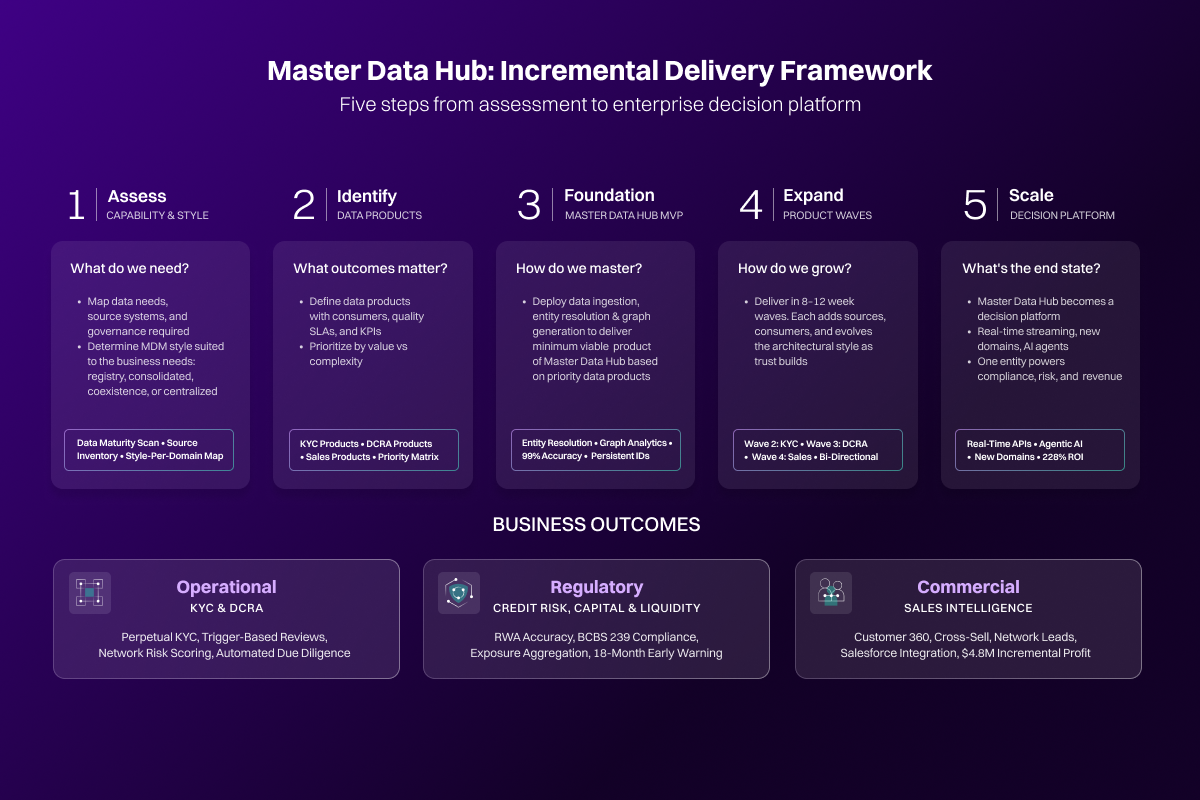
1. Assess | Understand what you actually need
Before choosing technology, banks need a clear view of their data landscape. Where does customer data live? How many systems claim to be the “source of truth”?
This is where banks choose the right MDM style per domain. Customer data may start as a read-only registry. Regulatory entity data may need to be consolidated from earlier on. Architecture should follow the business need, not the reverse.
2. Identify | Determine what data products are tied to what outcomes
KYC, risk, and commercial teams collaborate to define how data may be used for specific business outcomes. Defining data products such as a 'Customer Profiles' for KYC, a 'Dynamic Risk Score' for credit risk, or a 'Customer 360 Product' for relationship managers. Each data product should have a clear data consumer, a data sourcing contract, and a measurable data quality KPI. Prioritize ruthlessly and start with the data products that deliver the most value with the least complexity.
3. Build | Create the Entity Resolution core
Traditional matching breaks down when data is incomplete or inconsistent. Entity Resolution connects external and internal data to create context, conveying entities’ relationships to each other through relationship graphs. This is typically where the first data product is delivered: a resolved customer or counterparty core with persistent identifiers.
4. Expand | Deliver in cycles as the architecture evolves
With the core in place, aim to deliver additional data products in short cycles, often 8–12 weeks at a time. Each wave adds new sources, new entity domains, and new consumers. As trust grows, architectural style evolves from registry to consolidated views to coexistence with operational systems. This is not a “one-and-done” migration; it’s an incremental process.
5. Scale | Expand from data hub to decision platform
Over time, the hub evolves from a data management exercise into a decision-ready platform, serving risk teams, front-line staff, and AI agents. The same resolved entity supports KYC, feeds credit risk models, enables sales intelligence, and grounds generative AI. One investment delivers many outcomes.
Here’s the key: You don’t need to solve everything upfront. Start with one domain, one use case and one data product. Prove it works, and then expand.
Creating a Master Data Hub to power apps and agentic AI
Once in place, a master data hub becomes more than a data layer. It becomes the missing link for AI enablement, allowing banks to deliver trusted AI outcomes across a range of Agentic and Gen AI solutions.
Instead of retrieving information from fragmented systems, AI now accesses trusted, contextual data products. Responses are grounded in real customer and counterparty context, and outputs are consistent, explainable, and auditable. When Entity Resolution is combined with highly connected view of data using graph, AI-driven processes work with connected, ground-level information to drive real business outcomes, such as accelerating KYC approvals, sharpening credit risk decisions, and surfacing fraud patterns that siloed data would have missed entirely. These master data products are also consistently used across other consumer channels such as Customer Onboarding and Acquisition applications.
Of course, banks need a clear blueprint to modernize their master data management to go beyond governance to create a unified data layer across operations, sustainability, governance, and AI implementation. In the next blog post, we’ll walk through a blueprint for an AI-ready master data hub, integrated with business applications and Agentic solutions.
Ultimately, the last thing any bank needs is another multi-year MDM program that will only deliver value down the line. Rather, they need to start small, deliver one reusable data product, prove its worth and then scale. Banks need a master data hub that immediately confers an advantage, improving tomorrow’s decisions today.
Speak to one of our data experts to find out how to build your Master Data Hub.