How Defense Organizations Maximize Operational Impact Using Decision Intelligence
By unifying structured and unstructured data from multiple sources, defense teams can detect hidden patterns, visualize relationships, and prioritize responses with precision.
How Defense Organizations Maximize Operational Impact Using Decision Intelligence
By unifying structured and unstructured data from multiple sources, defense teams can detect hidden patterns, visualize relationships, and prioritize responses with precision.




Data is fuel for defense organizations. But vast amounts of data can thwart progress for critical analysis. Organizations are often overwhelmed by data from multiple complex domains and sources.
The disconnection of data sources creates a less-effective environment for impactful operations. Today’s threat picture is diverse and complex, which means unifying and contextualizing data for precise, timely insights is critical. Integration of structured and unstructured data and traditional and non-traditional sources is critical to identify emerging threats and risks, visualize relationships, detect hidden patterns, and uncover non-obvious connections.
Decision Intelligence, the latest step in the evolution of business intelligence, provides the necessary integration and context needed. Decision Intelligence uses Artificial Intelligence to provide a single, unified analytical view to help analytical and operational handlers make faster, more accurate decisions through human-machine augmentation.
How decision intelligence detects and neutralizes threats
In today's complex threat landscape, effective security demands more than just reactive measures—it requires a comprehensive approach to data-driven intelligence. By integrating data from various sources, defense organizations can build a robust foundation that allows for rapid onboarding of any data type, whether internal or external, structured, or unstructured. Once data is unified, powerful tools like Entity Resolution and graph analytics transform isolated information into a connected, dynamic view of entities and relationships, uncovering essential insights about networks, behaviors, and potential risks.
With this intelligence infrastructure, analysts gain the capability to generate contextual insights and understand the broader patterns surrounding key entities such as individuals, regions, assets and events. This context-rich analysis empowers decision-making through explainable AI and advanced scoring models, enabling proactive threat assessment. Finally, actionable intelligence is prioritized to disrupt imminent threats and ensure the swift allocation of resources, whether that is through real-time ISTAR, targeted financial controls, or other tactical operational responses. This unified intelligence process offers a comprehensive strategy to address potential threats effectively and efficiently.
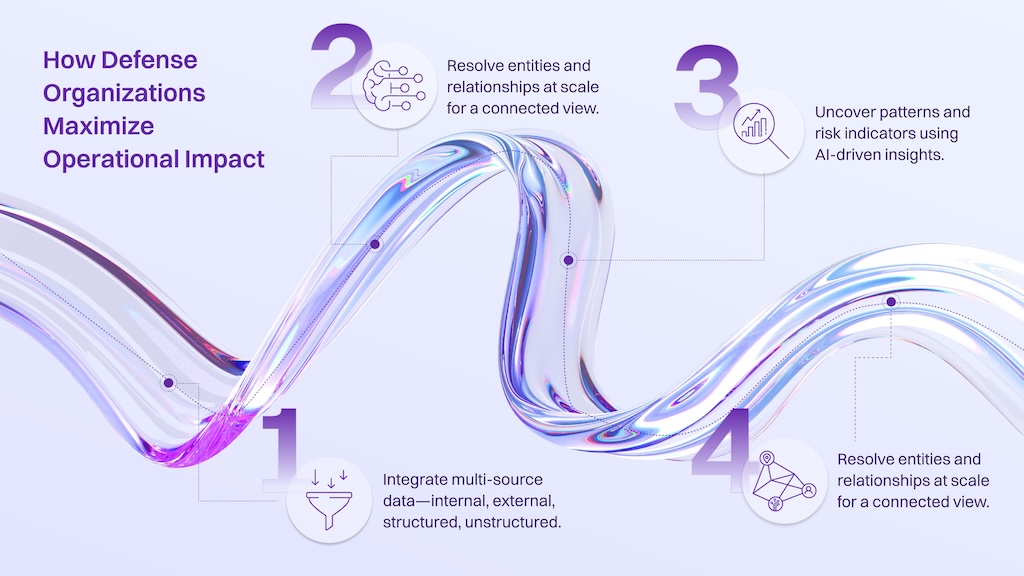
Ingest data: Integrate data from sources at scale to build a trusted data foundation. With multi-source data ingestion, you can rapidly onboard any source – internal, external, structured, or unstructured.
Unify data and create context: With Entity Resolution, analysts can connect siloed, disparate, and messy data at scale for an accurate single view. Identities are resolved across the integrated data. Graph analytics capabilities build dynamic networks and knowledge graphs that uncover vital intelligence about the network of relationships and behaviors among people, assets, locations, and activities.
Generate contextual analysis: Uncover entity, event, and graph level insights for context rich scoring models and explainable AI. For example, the decision intelligence process can identify subtle changes in data which may depict potential material increase in risk within a region or network.
Prioritize actions: Risk scoring can then be used to prioritize the actions that should be taken, for example, deploying operational assets or freezing particular accounts.
How smarter decision-making drives success
This is just one of many scenarios where Decision Intelligence can provide greater impact. As Gartner recently noted, "In times of increasing complexity and uncertainty, decision-making as an organizational capability will become a main competitive differentiator. Those who are able to make better, faster decisions will win in the market."