Creating Competitive Advantage from Your Bank’s Data Chaos
Here’s how banks can use AI to transform fragmented, siloed data into a strategic asset that drives new revenue streams.
Related Content:

Transform Your Bank with AI and Data
Read moreCreating Competitive Advantage from Your Bank’s Data Chaos
Here’s how banks can use AI to transform fragmented, siloed data into a strategic asset that drives new revenue streams.




The digital transformation of the banking industry has created an explosion of data, making it increasingly difficult for financial institutions to keep up with the onslaught of information.
Powerful new technologies, like large language models (LLMs) and Gen AI, are having a huge impact on efficiency in client-facing operations and risk management environments. The move to digitization, has also made understanding the data behind customer touchpoints and behaviors even more essential.
Add to this the increase in external data spurred by the growing emphasis on Environmental, Social, and Governance (ESG), automated call notes and recordings, digitization of payments and trades, and the increase in the ability to process unstructured data like news, and it's not surprising that banking leaders are feeling overwhelmed.
Looking at transactions alone, the Federal Reserve Board notes that the Automated Clearing House (ACH) network in the US, which handles debit and credit card transactions, processed a daily average of 80.1 million items in 2024. And Capital One reports that the world’s three largest credit card processors facilitate over 700 billion transactions each year.
The great data dilemma in banking
While this massive influx of new data would seem challenge enough, mergers and acquisitions have added even more data to the pipeline, making it ever more difficult for decision-makers to find the right data when they need it most.
Adding to the struggle is the constant pressure on banking leaders to deliver better service, improve efficiency, reduce risk, and find new ways to innovate and grow revenue streams—all amidst a swirling state of data chaos driven by siloed systems, inconsistent quality, and limited accessibility.
And while Artificial intelligence (AI) shows great promise to potentially relieve some of the data problems that are hamstring banking institutions, it’s not a silver bullet. Used effectively to supplement (not replace) institutional knowledge and human expertise, AI can unlock the value of data. But it can only do so if it is fed the right information. Only by organizing, contextualizing, and making their data accessible can banks begin to unlock powerful AI-driven insights, streamline operations, and deliver superior customer experiences.
Building a trusted data foundation
To bridge the gap between disconnected, siloed data resources and smarter decision-making, banking leaders need to bring structure to their data—and context to their data insights. This requires building a single source of truth—a trusted data foundation that can provide accurate, single views of your data and a deeper understanding of relevant connections to build better-performing models, data-driven insights, effective AI, and ultimately, improved impact and results enterprise-wide.
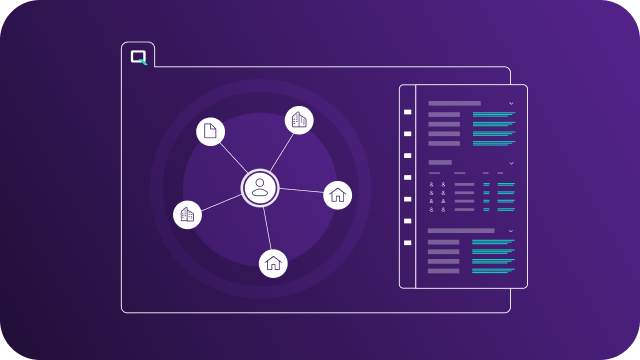
That technology exists today in solutions like Quantexa’s Decision Intelligence Platform, which provides forward-leaning banking institutions the ability to cleanse, enrich, match, and understand their data by connecting siloed sources through the use of AI, and publishing and visualizing complex relationships through real-world context. Knowledge graphs, which are flexible, dynamic data models that connect people, entities, transactions, and events across systems, are key to this process of unifying data.
Instead of organizing data by source or channel, knowledge graphs organize it by relationship. They create a holistic view by linking your bank’s internal data—like information in your customer relationship management (CRM) systems, transaction histories, and risk assessments—with external signals such as corporate registries, market events, and regulatory updates.
Contextual fabric provides unifying, accurate, knowledge-infused goodness that uses and feeds back into data management, science, analytics, and business workflows. At its simplest, a contextual fabric is a versatile real-world view of connected data enriched with contextual information to support enterprise-wide data utilization and decisioning.
Used together in Quantexa’s Platform, knowledge graphs and contextual fabric, supplemented by entity resolution and machine learning, provide a single view of data that can help marketing teams in banking understand churn and opportunity, risk managers assess lending risks, and fraud analysts identify bad actors.
Activating data with AI
Most banking institutions are already using AI to assist operations, but the real long-term value of AI comes when it is fully integrated across all aspects of your business to drive new revenue streams, mitigate risks, and improve customer relationships.
The biggest challenges for bank leaders to fully utilize the power of AI, however, are transparency, explainability, and accuracy of the results generated by the models in order to meet all regulatory requirements. This is where Retrieval Augmented Generation (RAG) can surface insights from vast datasets to incorporate secure, real-time insights from your internal data resources without having to retrain your core AI model to keep your responses up-to-date, accurate, and aligned with your business as well as provide clear lineage of every insight.
Integrated into daily operations this way, AI can become a partner for everyone in your organization. Relationship managers (RMs) can ask natural-language questions to find out which clients are most exposed to supply chain risk in China. Teams investigating fraud can spot anomalies such as funds being repeatedly funneled to a shell account before losses occur. And marketing teams can create 1-1 personalized content at scale.
Empowering relationship managers
Historically, RMs have been forced to spend inordinate amounts of time gathering and interpreting information—prepping for meetings, hunting for cross-selling opportunities, filling out forms, and responding to client questions. Gen AI tools change all of that.
With the right technology, RM’s now have the capability to gain a detailed understanding of every client’s profile, activity, and risk with context! Instead of spending hours on research, their time can now be used to provide customers with faster responses and more productive conversations that can lead to lead to deeper, long-lasting, and more profitable relationships.
Gaining the competitive edge
Faster decision-making, improved customer satisfaction, and operational efficiency are goals that every bank leader is striving to achieve. Solutions like Quantexa’s Decision Intelligence Platform can help make those goals a reality—connecting and contextualizing data using entity resolution, graph technology, and Generative AI to transform how insights can be accessed and applied across your entire organization.
Used in conjunction with a trusted data foundation, Gen AI presents a powerful opportunity for your bank to transform how it operates; not by replacing human intuition and expertise, but by enhancing it so that everyone on your team use Gen AI capabilities to enable real and measurable business outcomes.
We encourage every banking leader to take a step back and make a conscious effort to assess your data readiness by asking:
Is your data easily assessable to the right people when they need it most?
How can you bring all of your vast data resources together to provide a single source of truth to drive better decision-making?
What might the outcomes look like if your RMs could confidently walk into customer meetings armed with AI-generated summaries tailored to each client showing their latest transactions, relevant news mentions, relationship history, and even emerging risks?
What platforms are available that can support your organization’s transformation from data chaos to strategic clarity?
Choose the right partner
Finding the right tech partner takes careful scrutiny, but searching carefully now can save massive headaches down the line. The best advice is to look for organizations that go beyond merely providing software to partners that can deliver data strategy, domain expertise, and proven ways to implement the right technology to help you achieve your AI goals. With the right partner and platform, your bank will quickly be able to pivot to the best opportunities faster, become more responsive to your customers, and grow more competitive with AI that drives better, smarter, and more efficient decision-making.
To learn more about how your bank can turn fragmented data into a strategic asset using AI, download this easy-to-follow guide.
Related Content: